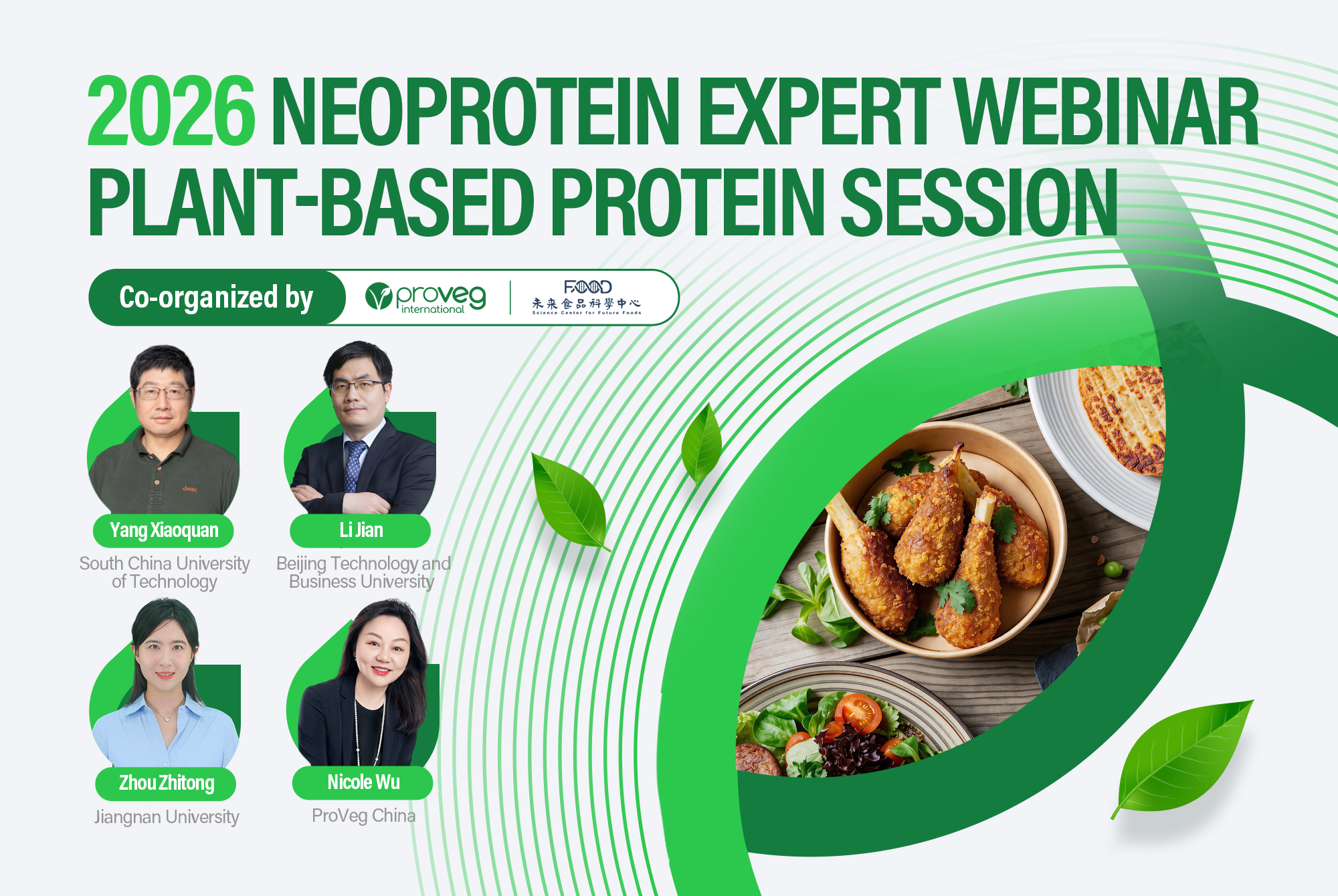

On 24 June, ProVeg China and Jiangnan University hosted the second webinar in the NeoProtein Expert Webinar series, with over 3,300 participants from academia, industry, and the wider food innovation community.
The webinar focussed on the first two challenges in the 2025 Top 10 Technical Challenges in NeoProtein Blue Paper: green and efficient extraction of low-denaturation plant proteins, and improved structure, juiciness, and flavour strategies in plant-based meat analogues.
The session featured three leading experts:
• Yang Xiaoquan, Professor, South China University of Technology
• Li Jian, Professor, Beijing Technology and Business University
• Zhou Zhitong, Assistant Research Fellow, Jiangnan University
Moderated by Nicole Wu, Executive Director of ProVeg China, the discussion provided a comprehensive overview of key bottlenecks in plant protein functionality, flavour, texture, and processing, alongside recent research progress and emerging solution pathways. Plant proteins from legumes, nuts, cereals, and seeds remain a core pillar of the plant-based food system, yet still show clear gaps in sensory and functional performance compared with animal proteins.
Key expert insights included:
- Plant proteins continue to face structural and functional constraints that limit key consumer attributes, including texture, juiciness, and flavour delivery.
- Functional limitations are particularly pronounced in gelation, as well as water- and oil-holding capacity, posing significant challenges for high-quality meat analogue development.
- Off-flavours—especially beany and bitter notes—remain a major obstacle to broader consumer acceptance.
- Addressing these challenges requires integrated innovation across protein extraction, structure modulation, flavour optimisation, and processing technologies.
Experts highlighted several promising solution pathways:
- Green processing technologies to better preserve protein functionality through improved control of protein structure and hydration while reducing processing intensity.
- Directional freezing techniques to enhance fibrous texture formation and improve juiciness.
- Dry and aqueous fractionation approaches for mild protein extraction while maintaining native protein structures.
- Multi-protein blending strategies to achieve more balanced and desirable flavour profiles.
- Emerging processing technologies, including fermentation and integrated “one-pot” processing, to improve production efficiency and expand application potential.
Participants included researchers, some of whom are involved in or preparing applications for NeoProtein-related research projects. Feedback suggested that the webinar helped improve understanding of current technical challenges and provided useful reference points for ongoing research planning.
The next webinar will take place on 22 July and will focus on cultivated proteins.