
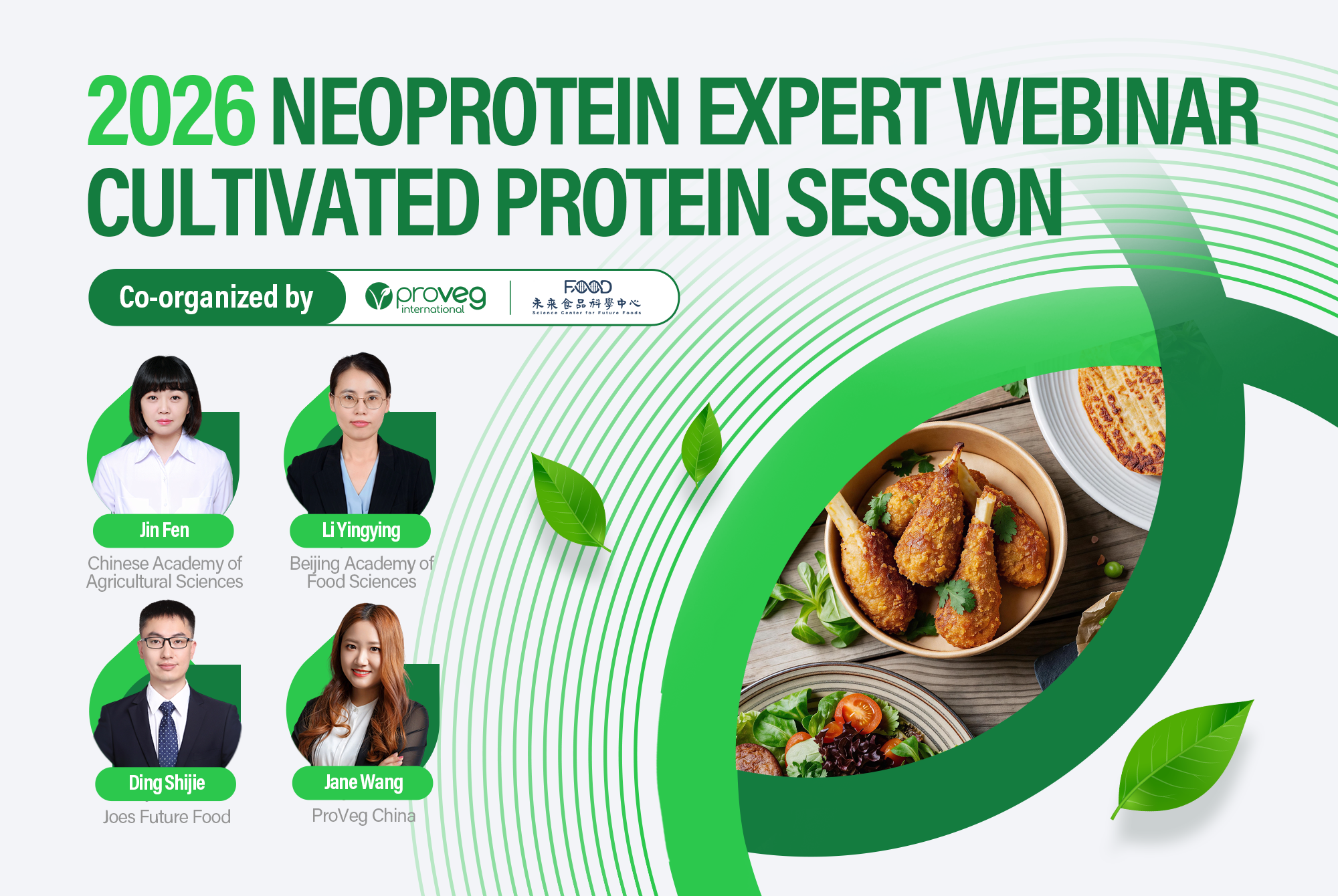
On 22 July, ProVeg China and Jiangnan University hosted the third session of the NeoProtein Expert Webinar Series, focusing on cultivated protein (cultivated meat). The session attracted over 1,600 participants from research institutions, industry, and related fields to discuss critical technological challenges shaping the future commercialization of cultivated protein.
Building on the 2025 Top 10 Technical Challenges in NeoProtein Blue Paper, jointly developed by ProVeg China and the NeoProtein Professional Committee of the Chinese Institute of Food Science and Technology (CIFST), the webinar explored three key challenges in cultivated protein development: food safety assessment and standards frameworks, the creation of stable and high-quality cell lines, and scalable manufacturing technologies. The Blue Paper brings together insights from 48 experts to identify major technological barriers and support coordinated innovation across academia, industry, and policymakers.
The session featured three leading experts:
- Jin Fen, Deputy Director of the Institute of Quality Standards and Testing Technology for Agro-Products, Chinese Academy of Agricultural Sciences
- Li Yingying, Deputy Director of Beijing Academy of Food Sciences
- Ding Shijie, General Manager of Joes Future Food
Moderated by Jane Wang, Senior Strategic Project Manager at ProVeg China, the webinar highlighted three key priorities for advancing cultivated protein commercialization:
- Commercialization starts with robust safety and regulatory frameworks. Developing cultivated protein requires comprehensive, science-based safety evaluation across the entire production chain—from cell lines and culture media to manufacturing processes and final products—while aligning with evolving international regulatory frameworks.
- High-quality cell systems are the foundation for scalable production. Stable, functional cell lines and advances in cell engineering are critical to improving production efficiency, product quality, and consistency, enabling cultivated protein to move from laboratory research to industrial-scale manufacturing.
- Building food-ready cell manufacturing systems is key to commercial success. Future progress depends on integrating biotechnology, food science, and advanced manufacturing to develop efficient, scalable production systems while creating cultivated protein products that deliver on nutrition, taste, texture, and quality—bridging the gap from laboratory innovation to everyday food applications.
With the successful completion of the three sessions of the NeoProtein Expert Webinar Series, ProVeg China extends its sincere appreciation to Jiangnan University for its valued partnership and support. We look forward to continuing our collaboration through future initiatives that foster knowledge exchange, strengthen cross-sector collaboration, and accelerate innovation across the NeoProtein industry.