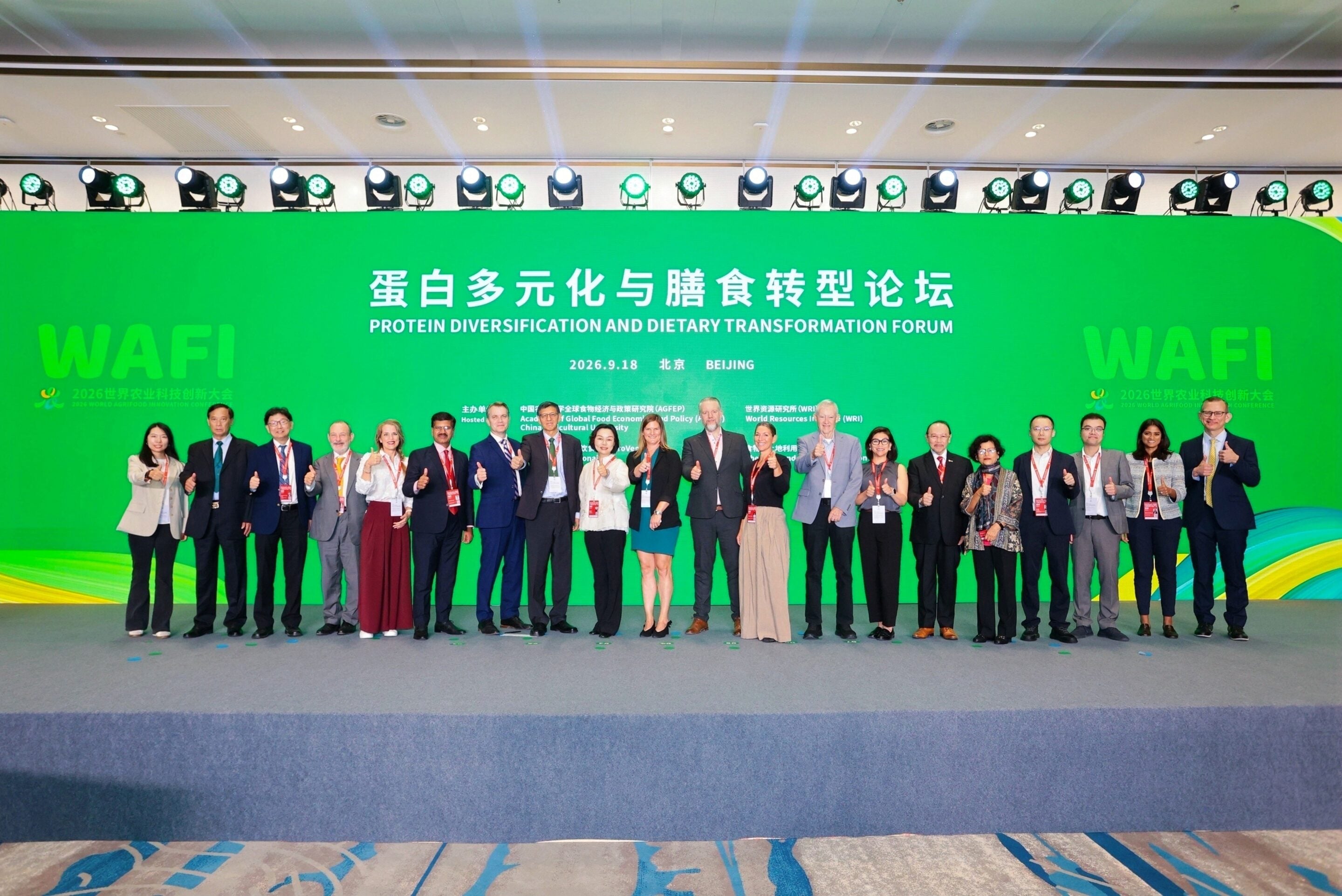
The Protein Diversification and Dietary Transformation Forum was held on 18 September 2026 in Pinggu, Beijing, as part of the 2026 World AgriFood Innovation (WAFI) Conference, with more than 200 participants attending in person.
The forum was co-organised by ProVeg China, the Academy of Global Food Economics and Policy (AGFEP) at China Agricultural University, the World Resources Institute (WRI), and the Food and Land Use Coalition (FOLU). Bringing together perspectives from across the food system, it explored how protein diversification can contribute to healthier, more sustainable and resilient food systems—and what it will take to move NeoProtein from technological breakthroughs to industrialisation and market adoption.

Protein diversification is part of a broader food-system transition
The forum opened with remarks from Yin Shuangfeng, Deputy Head of Pinggu District, Beijing, highlighting Pinggu’s strong commitment to developing NeoProtein, including dedicated policy support and an ecosystem spanning research, technology transfer and industry. Craig Hanson, Managing Director and Executive Vice President of the World Resources Institute, highlighted protein diversification and healthier diets as important elements of a sustainable food future, and stressed the role of innovation in building more resilient food systems.
Distinguished speakers offered perspectives on nutrition, food policy, NeoProtein innovation and food science. The discussion highlighted that protein diversification goes beyond new sources of protein—it is also about how our food system is evolving in the way food is produced, supplied and consumed.

For China, this aligns with the “Big Food Concept”, including efforts to diversify food sources, strengthen food-system resilience and respond to evolving nutritional needs. The first high-level dialogue, “Dietary Transformation and Healthy, Sustainable Agrifood Systems,” further highlighted that dietary change depends not only on consumer choice, but also on affordability, accessibility, food environments, public policy, nutrition and food production.

Together, these discussions set the context for the forum’s second question: what will it take for NeoProtein innovation to move from technological breakthroughs to real-world market adoption?
From Technological Breakthroughs to Market Adoption
This question was at the centre of the second high-level dialogue, “Industrialisation of NeoProtein: From Technological Breakthroughs to Market Adoption,” moderated by Nicole Wu of ProVeg China. The discussion brought together perspectives from research, regulation, investment and food-system development, spanning plant-based, fermentation, insect and other emerging protein pathways.

1. Technical innovation remains the starting point—but products must work in the real world
Speakers noted encouraging technical progress, from improved plant protein flavour to new yeast proteins, while emphasising that translating laboratory results into processes that work at industrial scale is an important next step. Technology therefore continues to play an important role as the foundation for what follows.
Equally important are application scenarios. NeoProtein does not need to replicate conventional animal products; simply imitating meat may limit how we imagine the role of protein. Opportunities also exist in familiar foods such as tofu, high-protein bread and beverages. As one speaker put it, the winners may not be those with the newest technology, but those that embed NeoProtein in products and value chains consumers already rely on, meeting expectations for taste, functionality, quality and cost.
2. Industrialisation requires technology, scale-up, regulation and demand to move together
The discussion then turned to the path from technical innovation to commercialisation, speakers emphasised that bringing NeoProtein to market depends on more than the technology itself. Manufacturing capacity, infrastructure, regulation, financing and industry partnerships need to evolve alongside the technology.
The discussion also highlighted the link between finance and demand. More predictable demand—through commercial partnerships, long-term supply agreements and committed offtake—can reduce uncertainty and unlock investment for scale-up. Finance, partnerships and demand therefore need to move together.
Speakers drew parallels with China’s experience in solar and electric vehicles, where policy, capital, technology, industrial capacity and demand developed together to support scale-up. While food presents a different context, the broader lesson is that NeoProtein will require coordinated progress across technology, industry, finance, regulation and demand.
3. Ultimately, market adoption means creating foods people want to eat repeatedly—and making them fit the way people eat
One of the clearest messages from the discussion was that consumers do not choose a protein technology—they choose food. Taste, quality, price, convenience, familiarity and trust therefore matter as much as the underlying technology.
NeoProtein needs to be embedded in products, brands and value chains that consumers already understand and use. This also means fitting naturally into existing eating habits, food cultures and social occasions. One China-specific observation was the importance of shared eating: food is often enjoyed collectively, with dishes shared among family, friends or colleagues rather than chosen individually. This can shape how consumers encounter and choose plant-based or other new-protein foods.
Building trust through credible regulation and standards, developing strong products and brands, and creating familiar consumption occasions can help new proteins move beyond early adopters.
Taken together, the discussion showed that moving from technical breakthrough to mainstream adoption is a systems challenge. Technology needs to advance alongside scalable production, credible regulation, fit-for-purpose finance and stronger market signals. Ultimately, NeoProtein will scale when it is not only technically viable, but also fits the foods, value chains and everyday occasions people already know and choose.

Additionally, Nicole Wu was invited to speak at WAFI’s parallel Agrifood Innovation & Investment Forum, joining the roundtable “From Innovation to Adoption: Scaling Agrifood Solutions Across Borders.” She further emphasised that moving NeoProtein from innovation to market adoption is not simply about getting consumers to try new products, but about earning repeat purchases by meeting core needs such as taste, affordability and safety.
Thank you to WAFI for providing a valuable platform for this exchange, and to all the speakers and participants for contributing their perspectives to the discussion.