Much has been said about the challenges of feeding teenagers and their preferences for unhealthy, fast, and ultra-processed foods. Often steering clear of diversity and wholefoods, beige options are what come to mind when we think about young people’s diets. While school caterers strive to design inspiring and nutritious menus, operational constraints often present significant hurdles.
ProVeg UK’s pilot project, Transforming Secondary School Catering to Improve Children’s Health, at Little Ilford Secondary School in Newham shows how student participation can improve health, protect the environment, and elevate the school food experience by putting young people front and centre.
How much do young people know about the link between food, health, and climate?
With the support of Newham Council, ProVeg held two sessions with Little Ilford’s students in May. The team engaged with 49 students in a lively food, health, and climate focus group. While the students understood the benefits of eating a diverse diet that prioritises whole food and sustainability, many remained sceptical of how plant-based food actually tasted. We know taste is a huge driver for how young people make mealtime choices. Some mentioned that these meals sounded “bland”, “gross”, and one student said they “have never been open to eating it”. Yet the appetite for change was already there.
When asked about Meat-Free Days, 82.6% (of the 46 students) said they would support them or be open to them if the options looked appealing, and over a third (34.7%) said they would eat more plant-based food if its nutritional benefits were clearly shown on the menu.
When asked which plant-based dishes they would like to see, students voted for global street food, rich in pulses and wholefoods, with Mexican-style chilli top of the list (38 votes), followed by falafel wraps (26) and a crispy tofu noodle bowl (18).
Time to get cooking!
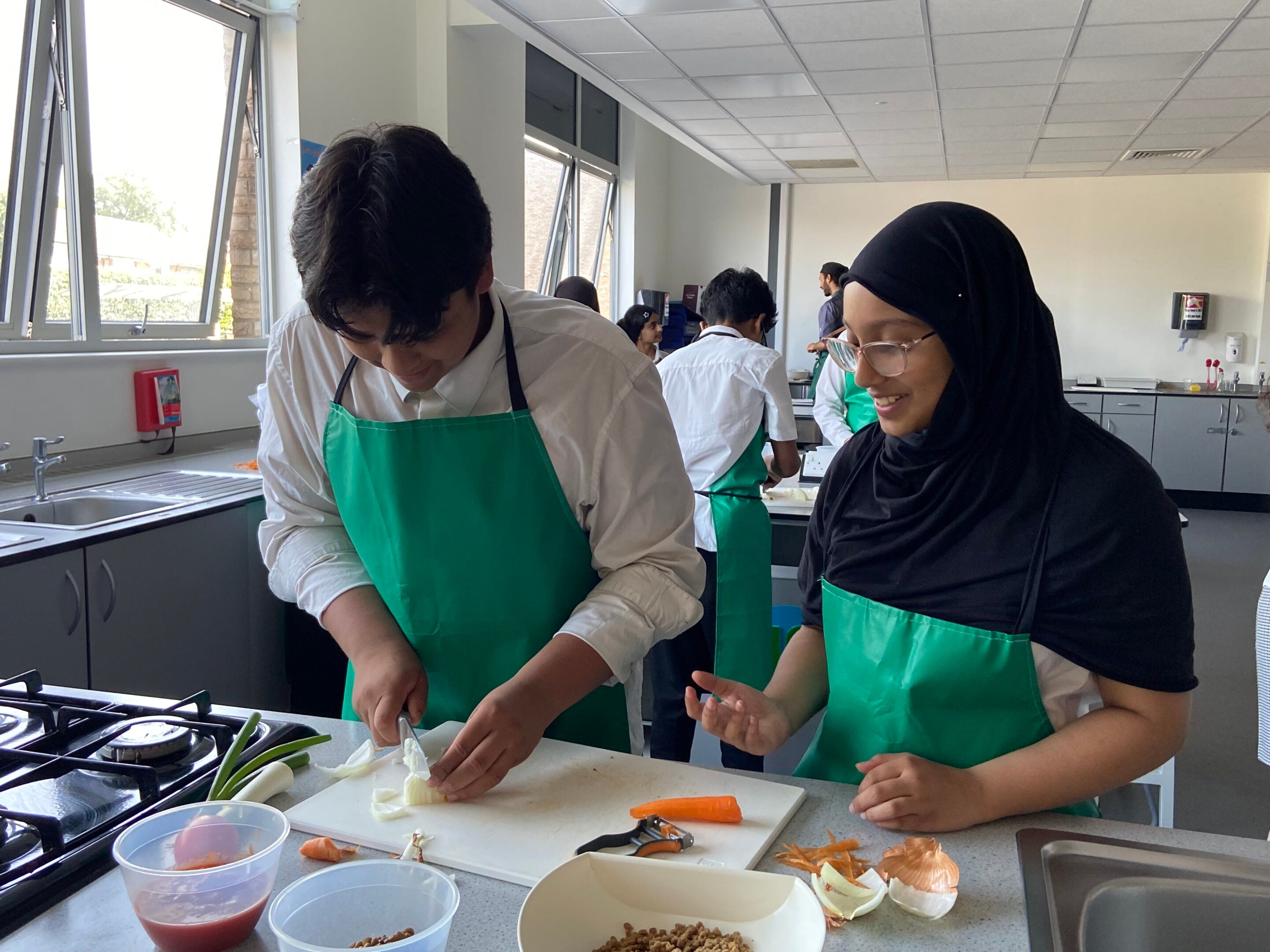
On 25th June, an extremely hot day during London Climate Action Week, the team returned to the school for the second and practical workshop “Cooking with Plants”. During this session, 19 students, from years 7, 8, and 9, discussed more about the connections between food, their health, and the planet, but most importantly, had the chance to experience cooking a Mexican bolo-chili recipe served with nachos, and to see our Chef demonstration preparing cookie dough bites made with chickpeas. The chilli was a nutritional winner too: each portion provides 8.4g of fibre and 16g of protein with just 0.8g of saturated fat, and with carbon emissions of 0.72kg it is rated a low-impact meal. Seeing the students roll up their sleeves and engaging with plant-based ingredients was the highlight of the day.
From students trying lentils for the first time, to a young boy so inspired that he went out to buy ingredients to cook the same dishes to his family, the impact was immediate. One of the pupils asked “Can we have this on the school menu?”, proving the workshop’s success in changing perceptions about plant-based food.

What was the impact?
This experience transformed the students’ scepticism into pride. The kitchen was filled with excitement as students tried their creations and realised that plant-based options can be delicious, and simple. Asked what they think about plant-based dishes following the workshop, the majority changed their minds about the taste of dishes rich in wholefood plants.
After the workshop, 89.5% of participants (17 out of 19) said they would definitely or probably choose a plant-based option in the canteen, and every one of them agreed that they understood the impact of their food choices on their health and the planet. The session ended with many other teachers joining us to try the food, and being surprisingly delighted by the quality of the dishes the students produced. One teacher was so impressed that they asked for the workshop to be extended to Year 10 and 11 students next term. A true sign of how plant-rich menus can be accepted by different generations, tastes, and backgrounds.
Year 1 of the pilot built strong student support by giving pupils hands-on experience cooking tasty plant-based meals. As the School Food Standards are set to transition to high-fibre, low UPF, and pulse-rich catering, this pilot demonstrates that it is possible to create change that is accepted and championed by pupils. With the special support of Kathy d’Apice, School Food Strategist from London Borough of Newham, and the enthusiastic leadership of Ladi Oloyede, Teacher of Design and Technology at Little Ilford, this opportunity reinforced our mission to serve more delicious and nutritious food that is good for children and for the planet.
To find out how your secondary school can get involved, reach out to us at [email protected].