



The €11 Billion Opportunity
Unlocking the economic potential of plant-forward public food procurement in the EU
Policy report and economic modeling
June 2026
The European Union has recognized the need for public food procurement to move beyond lowest cost and to reward sustainability and social goals. The current question is which frameworks deliver these benefits while minimizing red tape and maintaining or even enhancing economic competitiveness
Based on economic analyzes across all 27 EU Member States that models the impact of shifting to plant-forward* public procurement, this report demonstrates that food procurement standards that prioritize plant-source foods offer a solution to these challenges.
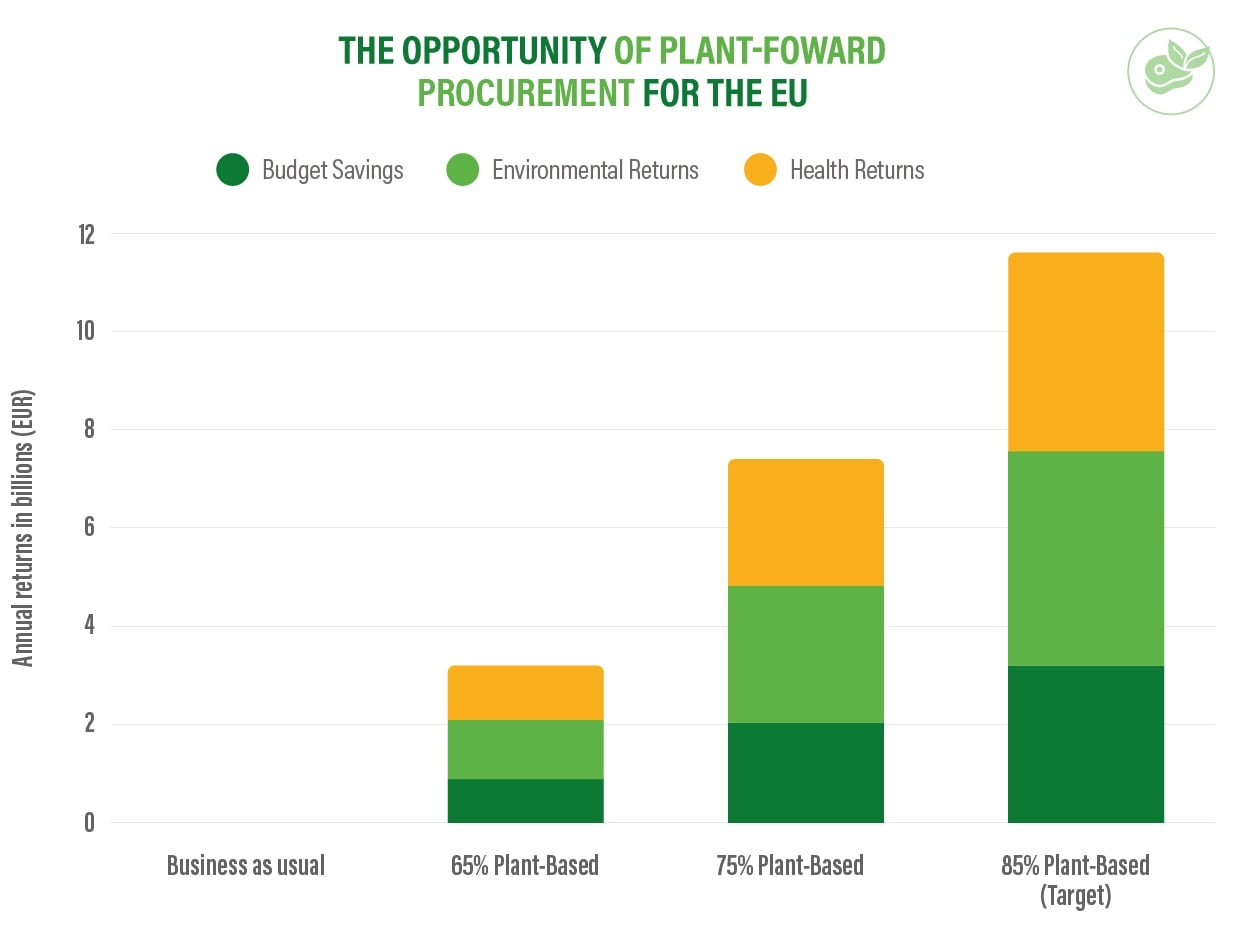
Under an ambitious target scenario of allocating 85% of public food procurement budgets to plant-source foods, the EU would unlock roughly €11.61 billion per year in combined savings:

€3.16 BILLION
in direct budget savings: plant-forward menus cost less at the ingredient level, freeing funds for other priorities such as organic and local sourcing.

€4.08 BILLION
in social health cost reductions, valued using the OECD’s value-of-statistical-life methodology applied to IHME Global Burden of Disease data.

€4.37 BILLION
in environmental externality reductions, covering climate, air and water pollution, land use, and scarce water withdrawal. We monetise these using True Cost Pricing methodology.
Plant-forward public procurement is consistent with the EU’s strategic food priorities: it creates stable demand for EU-grown legumes, strengthening food security and strategic protein autonomy. It supports farmer diversification in line with the Common Agricultural Policy (CAP) 2028–2034 proposals. Lastly, it respects diverse culinary traditions through a simple budget-share rule rather than prescriptive menus.
RECOMMENDATIONS
1
Amend the EU Public Procurement Directive to replace lowest-cost bidding with sustainability-weighted evaluation that internalizes environmental and health externalities, and introduce a minimum 25% organic sourcing target for public food procurement.
2
Reform the EU School Scheme to expand eligible categories to include legumes and fortified unsweetened plant-based drinks.
3
Upskill the catering workforce by directing European Social Fund Plus (ESF+) funding toward training chefs to deliver nutritionally complete plant-forward menus.
4
Support farmers by establishing conditional supply contracts and a dedicated transition grant fund to de-risk those who want to transition to food-grade plant protein.
5
Implement behavioral nudges that are science-based and preserve freedom of choice, including plant-based defaults, strategic menu placement, and sensory focused labeling.
About the report
This policy report was developed based on original economic modeling commissioned from Bryant Research by ProVeg International. The research quantifies the budget, health, and environmental returns of shifting public food procurement across the EU27 toward plant-source foods. Methodology and results are detailed in the Technical Appendices, which can be accessed below.
*Throughout the report and appendices, ‘plant-forward’ is used to describe procurement spending that is centered primarily (but not necessarily fully) on fruits, vegetables, whole grains, legumes, nuts, and mushrooms, as well as plant-based alternatives to animal-source foods that are nutrient-rich and compatible with WHO guidelines on salt, sugar, and fat content.