



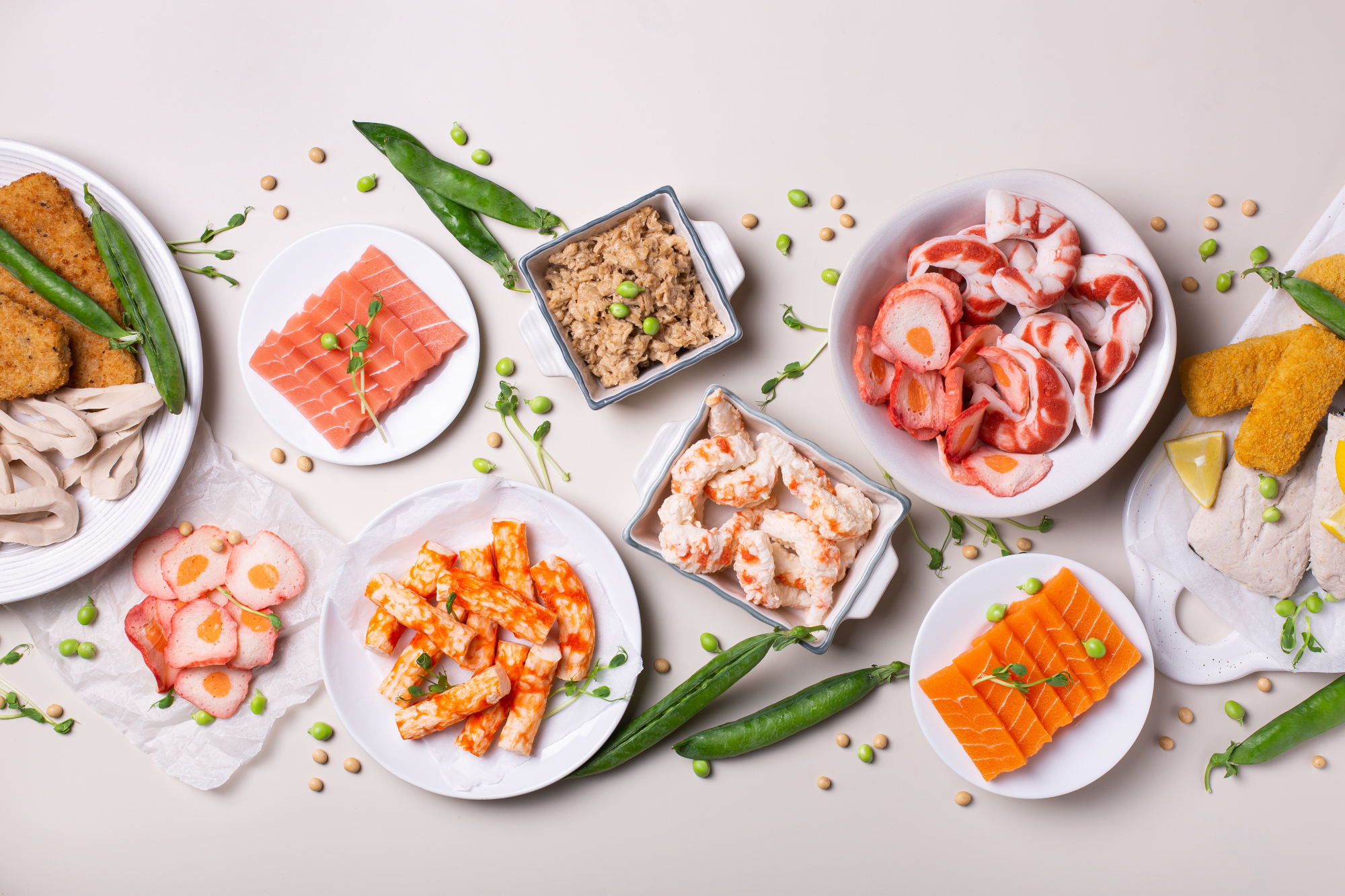
With nearly 40% of global fish stocks overfished and another 50% harvested at maximum capacity, the urgency to find sustainable seafood solutions has never been greater. Plant-based fish alternatives are emerging as a promising innovation, driven by rising consumer awareness of overfishing, environmental degradation, and animal welfare concerns.
References
[1] EFSA (2006): Nutrition claims. European Union, EFSA. Available at: https://www.efsa.europa.eu/ en/topics/topic/health-claims
[2] Soldán, M., Ľ. Argalášová, L. Hadvinová, et al. (2024): The Effect of Dietary Types on Gut Microbiota Composition and Development of Non-Communicable Diseases: A Narrative Review. Nutrients 16(18), 3134. Doi:10.3390/nu16183134
[3] Stephen, A. M., M. M.-J. Champ, S. J. Cloran, et al. (2017): Dietary fiber in Europe: current state of knowledge on definitions, sources, recommendations, intakes and relationships to health. Nutrition Research Reviews 30(2), 149–190. Doi:10.1017/S095442241700004X
[4] Dietary guidelines. USA. Available at: https://www.dietaryguidelines.gov/current-dietary-guidelines
[5] WHO (2023): Saturated fatty acid and trans-fatty acid intake for adults and children: WHO guideline. Geneva: World Health Organization. Available at: https://iris.who.int/bitstream/handle/10665/370419/9789240073630-eng.pdf.
[6] Maki, K. C., M. R. Dicklin & C. F. Kirkpatrick (2021): Saturated fats and cardiovascular health: Current evidence and controversies. Journal of Clinical Lipidology 15(6), 765–772. Doi:10.1016/j.jacl.2021.09.049.
[7] WHO (2020): Healthy diet. Available at: https://www.who.int/news-room/fact-sheets/detail/healthy-diet.
[8] Melville, H., M. Shahid, A. Gaines, et al. (2023): The nutritional profile of plant‐based meat analogs available for sale in Australia. Nutrition & Dietetics 80(2), 211–222. Doi:10.1111/1747-0080.12793
[9] Nagra, M., F. Tsam, S. Ward, et al. (2024): Animal vs Plant-Based Meat: A Hearty Debate. Canadian Journal of Cardiology 40(7), 1198–1209. Doi:10.1016/j.cjca.2023.11.005.
[10] Nájera Espinosa, S., G. Hadida, A. Jelmar Sietsma, et al. (2024): Mapping the evidence of novel plant-based foods: a systematic review of nutritional, health, and environmental impacts in high-income countries. Nutrition Reviews nuae031. Doi:10.1093/nutrit/nuae031.
[11] Wambogo, E. A., N. Ansai, A. Terry, et al. (2023): Dairy, Meat, Seafood, and Plant Sources of Saturated Fat: United States, Ages Two Years and Over, 2017–2020. The Journal of Nutrition 153(9), 2689–2698. Doi:10.1016/j.tjnut.2023.06.040
[12] Gonçalves, R. M., M. E. Petenuci, F. C. Maistrovicz, et al. (2021): Lipid profile and fatty acid composition of marine fish species from Northeast coast of Brazil. Journal of Food Science and Technology 58(3), 1177–1189. Doi:10.1007/s13197-020-04631-y
[13] McMullan, J. E., A. J. Yeates, P. J. Allsopp, et al. (2023): Fish consumption and its lipid modifying effects – A review of intervention studies. NeuroToxicology 99 82–96. Doi:10.1016/j.neuro.2023.10.003
[14] Abotsi, E. E., Y. Panagodage & M. English (2024): Plant-based seafood alternatives: Current insights on the nutrition, protein-flavor interactions, and the processing of these foods. Current Research in Food Science 9 100860. Doi:10.1016/j.crfs.2024.100860
[15] Santos, H. O., J. C. Price & A. A. Bueno (2020): Beyond Fish Oil Supplementation: The Effects of Alternative Plant Sources of Omega-3 Polyunsaturated Fatty Acids upon Lipid Indexes and Cardiometabolic Biomarkers—An Overview. Nutrients 12(10), 3159. Doi:10.3390/nu12103159
[16] Appiani, M., C. Cattaneo & M. Laureati (2025): Plant-based fish analogs vs. fish: Assessment of consumer perception, acceptance, and attitudes. Food Quality and Preference 123 105329. Doi:10.1016/j.foodqual.2024.105329
[17] Burns-Whitmore, B., E. Froyen, C. Heskey, et al. (2019): Alpha-Linolenic and Linoleic Fatty Acids in the Vegan Diet: Do They Require Dietary Reference Intake/Adequate Intake Special Consideration? Nutrients 11(10), 2365. Doi:10.3390/nu11102365
[18] Nicol, K., E.-L. Thomas, A. P. Nugent, et al. (2023): Iodine fortification of plant-based dairy and fish alternatives: the effect of substitution on iodine intake based on a market survey in the UK. British Journal of Nutrition 129(5), 832–842. Doi:10.1017/S0007114522001052
[19] Khalil, Z. A. & I. Herter-Aeberli (2024): Contribution of plant-based dairy and fish alternatives to iodine nutrition in the Swiss diet: a Swiss Market Survey. European Journal of Nutrition 63(5), 1501–1512. Doi:10.1007/s00394-024-03339-5
[20] WHO (2020): Healthy diet. Available at: https://www.who.int/news-room/fact-sheets/ detail/healthy-diet
[21] WHO (2025): Sodium reduction. Available at: https://www.who.int/news-room/fact-sheets/ detail/sodium-reduction
[22] Boukid, F., M.-C. Baune, M. Gagaoua, et al. (2022): Seafood alternatives: assessing the nutritional profile of products sold in the global market. European Food Research and Technology 248(7), 1777–1786. Doi:10.1007/s00217-022-04004-z
[23] Roberts, A. K., V. Busque, J. L. Robinson, et al. (2022): SWAP-MEAT Athlete (study with appetizing plant-food, meat eating alternatives trial) – investigating the impact of three different diets on recreational athletic performance: a randomized crossover trial. Nutrition Journal 21(1), 69. Doi:10.1186/s12937-022-00820-x
Frequently asked questions
What are the key facts about plant-based fish alternatives?
Nearly 40% of global fish stocks are overfished and around 50% are harvested at maximum capacity. ProVeg assessed 100 plant-based fish products across 11 countries and 3 continents. The assessment compares protein quality, micronutrient fortification and Nutri-Score against conventional fish. A 2023 survey found 42% of European consumers find plant-based seafood appealing, with 43% open to purchasing it.
Are plant-based fish alternatives nutritious compared to real fish?
ProVeg assessed 100 plant-based fish products across 11 countries and 3 continents, comparing protein quality, micronutrient fortification and Nutri-Score against conventional fish. With nearly 40% of global fish stocks overfished and 50% at maximum capacity, the aim is to ensure alternatives meet or exceed the nutrition of the products they replace. A 2023 survey found 42% of European consumers find plant-based seafood appealing.