



Unlocking the Potential of Precision Fermentation: advancing sustainable, resilient food systems in Europe
Precision fermentation provides a tool to address the urgent challenges facing today’s animal-based food system – including environmental degradation, food security, and questions of adequate nutrition.1 2 By harnessing the power of microorganisms – often referred to as cell factories – precision fermentation can produce functional ingredients such as animal-identical milk and egg proteins without the need for farmed animals.3 Such ingredients can further enhance the taste, texture, and nutritional content of food products, including plant-based alternatives. In doing so, they build on the strengths of current options and help them better align with consumer expectations.4 5
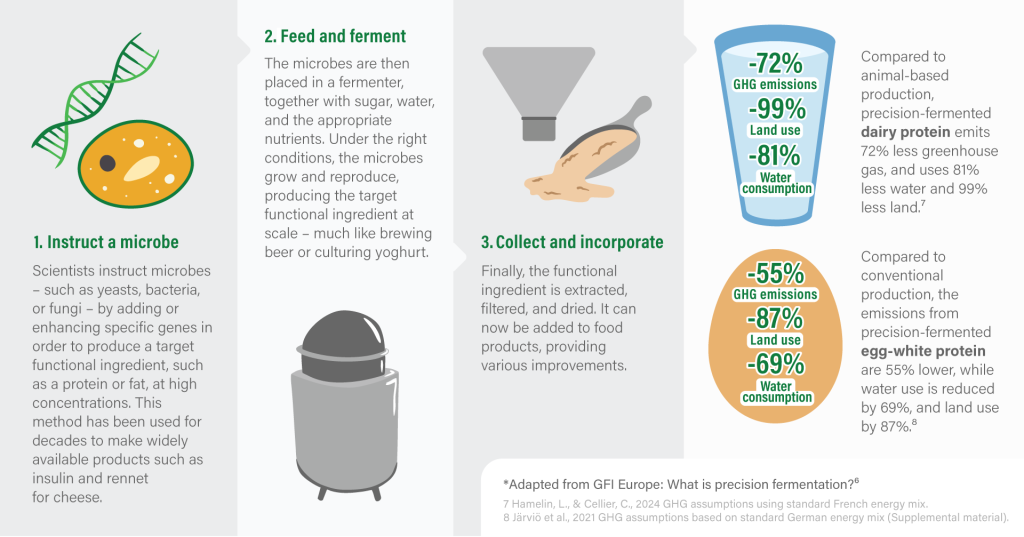
How precision fermentation works
“By integrating fermentation technologies into the EU’s policy agenda, Europe can position itself as a global leader in sustainable food production, ensuring long-term economic and environmental success in the agrifood landscape.”9
Food Fermentation Europe
At present, the core focus for precision-fermentation companies and researchers is on driving innovation and optimizing processes in order to reach commercial viability – and ultimately price-competitiveness – with animal-based products.10 11 Getting to the next phase will require continued commitment from both the public and private sector.
While Europe is currently a leader in the plant-based sector, governments and investors need to continue stepping up with transparent regulatory frameworks and sustained financial support, respectively, in order to accelerate the industry’s growth and unlock the potentially huge benefits of precision fermentation.12 In this evolving and financially intensive industry, cooperation and knowledge-sharing are likely to be key to improving current technologies and scaling production efficiently.13 14 15
Small cells, big impact
“Precision fermentation is paving the way for a transformation of the food industry, offering a new method to produce food by harnessing the power of microorganisms.”35
Food and Agriculture Organization
Precision fermentation: road to market
Despite its transformative potential, the EU’s precision-fermentation sector still faces several technical, financial, and regulatory barriers.
1. R&D
Researchers can already modify microbes in order to produce complex proteins such as casein and whey. However, moving from the lab to an industrial scale requires time, resources, and deep expertise.36

3. Financing gaps
Slow returns may deter private investors,39 while public funding might not be tailored to precision fermentation but rather available under generalized climate-change and bioeconomy programs.40
4. Feedstock and process sustainability
Many precision-fermentation processes still rely on sugar and high energy inputs, raising concerns about land use and carbon intensity.41 42 43
5. Regulatory delays
Regulations and regulatory support vary across regions. The EU’s EFSA novel-food approvals can take several years, impacting the speed of market entry for precision-fermented products in Europe, even as similar products gain approval elsewhere.44 45
“Public-private partnerships can help accelerate innovation by kickstarting research and development in areas of emerging technology, facilitating talent exchange and minimizing duplications in investments…Doing so will enable more viable pathways to translation, commercialisation, and scaling for impact.”48
Heng Swee Keat, former Deputy Prime Minister of Singapore
The path forward is clear
A growing number of examples, including from Denmark, Singapore, the US, and the UK, can be drawn upon to help Europe overcome key barriers and lay the groundwork for long-term success.
Despite the challenges, precision fermentation is advancing rapidly. As of May 2025, there were 186 companies around the world working in the precision-fermentation space, with 88 operating in Europe.49 And technological progress is continuing, with improved strains and higher protein yields making production more efficient and scalable.50 51 Industry collaboration is also gaining momentum, as reflected in the growing number of partnerships and the emergence of networks such as the Precision Fermentation Alliance, the Protein Club, and, most recently, Food Fermentation Europe.52 53 54 55 56 57
In 2024, European precision-fermentation companies raised €120 million – more than three times the amount raised in 2023.58 Meanwhile, regulatory clarity is improving, with the EFSA’s novel food policy having been updated in early 2025, helping to unlock further progress.59 60

Denmark a national model for innovation

A clear national strategy
Denmark’s whole-government approach en-compasses a suite of coordinated policies, including the Strategy for Green Jobs in Agriculture, the Strategy for Green Proteins, and the landmark Action Plan for Plant-based Foods. These programs collectively support fermentation as part of a broader and robust sustainable food transition.61 62


Public-private-academic alliances
Initiatives such as Biosolutions Zealand and Innovation Center Denmark bring together industry, academia, and government to accelerate innovation.65

Targeted public investment
The country’s Plant Based Food Grant will distribute over €130 million from 2023-2030 to plant-based innovation, with funding provided from farm to fork. Denmark recognizes that a strong national plant-based sector can drive economic growth, including exports and international expansion.66

Focus on a healthy diet
Plant-based foods, including precision-fermentation products, are promoted as a key to a healthier population and planet.67
Takeaway: While Denmark’s national strategies do not explicitly mention precision fermentation, the country actively fosters the technology through coordinated public, private, and academic efforts. Denmark’s whole-government approach to plant-based foods is creating an innovation-friendly ecosystem that is enabling precision fermentation to thrive. This commitment extends beyond national borders, with Denmark promoting supportive policies at the European level in order to advance sustainable food systems.68
Other governments driving precision fermentation forward
Singapore
Public-private innovation hub

Singapore’s Agency for Science, Technology, and Research, together with the contract-manufacturing organization ScaleUp Bio, supports a dedicated precision-fermentation hub at The Food Tech Innovation Center, helping alt-protein producers to scale and accelerate market entry.69
EU
Public funding of research projects

In 2024, €50 million was allocated to support the scaling up of precision-fermentation SMEs via Horizon Europe and the European Innovation Council’s work program.70 The Innovation Council also announced its continued support and funding for precision fermentation as a driver of the transition to low-emission food and feed systems.71
Sweden
International research initiative

Through Horizon Europe, the EU granted €5 million to the Research Institutes of Sweden’s nine-country consortium in order to improve the taste, texture, and nutritional value of non-dairy cheeses using precision fermentation in combination with complementary alt-protein technologies.72
US
Collaborative precision-fermentation hub

The university-led iFAB Tech Hub received €55 million from the US Economic Development Administration, along with €730 million from a broad public-private consortium, in order to scale up biomanufacturing, alternative feedstocks, and workforce readiness through nationwide collaboration.73
France
Precision fermentation for food security

To promote food sovereignty and sustainable innovation, France supported Standing Ovation’s precision-fermented milk protein with €3 million in loans and grants administered through the Agri-Food Resilience and Capacity initiative, and via the EU Green Investment Loan administered by Bpifrance.74
UK
Expanding regulatory and research capacity

The UK’s Department of Science, Innovation and Technology has invested €1.6 million in a new hub to strengthen regulatory expertise in precision fermentation.75 This builds on the three recently launched alt-protein centers which include a focus on precision fermentation and received around €45 million in funding from various governmental bodies.76
Despite all these developments in the precision-fermentation sector, progress isn’t guaranteed. Continued public and private support are both essential in order to turn potential into impact. According to the Good Food Institute Europe, Europe will need to invest €760 million a year in public funding in order to unlock the full potential of alternative proteins.77
KEY TAKEAWAYS
- Encourage transparent and efficient regulatory pathways: Protect food safety without stalling innovation. Streamlined and consistent approval processes are essential in order to attract investment and support commercial success in the precision-fermentation sector.
- Continue targeted public investment: Coupled with a continuous increase in private investments, public funding needs to increase across the value chain, particularly in R&D and scaling up. Instruments such as Horizon Europe, the European Innovation Council, and European Investment Bank financing should be leveraged in order to accelerate innovation and lower the risk levels around development.
- Foster knowledge-sharing and cross-sector alliances: Encourage collaborative public-private-academic partnerships as a way to tackle shared challenges. Precision fermentation addresses complex food-system issues – and optimizing its potential requires equally multifaceted collaboration
- Invest in optimisation for scale and affordability: Support efforts to improve yields, reduce costs, and enhance process efficiency, thereby laying the groundwork for eventual price competitiveness, broader market adoption, and food security
- Strengthen alignment with EU bioeconomy strategies: Explicitly name precision fermentation and other plant-based alternative technologies in the upcoming EU bioeconomy and biotechnology updates. This will help to legitimize their role in advancing Europe’s bioeconomy, as well as helping to unify the currently fragmented policy landscape and create a clearer path forward for research, commercialisation, and investment.
References
- GFI. (2025). State of the Industry: Fermentation for meat, seafood, eggs, dairy, and ingredients. https://gfi.org/resource/fermentation-meat-seafood-eggs-dairy-and-ingredients-state-of-the-industry/ [Accessed: 30.04.2025]
- Teng, T. S., Chin, Y. L., Chai, K. F., & Chen, W. N. (2021). Fermentation for future food systems. EMBO Reports, 22(5), e52680. https://doi.org/10.15252/embr.202152680
- Augustin, M. A., Hartley, C. J., Maloney, G., & Tyndall, S. (2024). Innovation in precision fermentation for food ingredients. Critical Reviews in Food Science and Nutrition, 64(18), 6218–6238. https://doi.org/10.1080/10408398.2023.2166014
- Smart Protein Project. (2023). Evolving appetites: An in-depth look at European attitudes towards plant-based eating. https://smartproteinproject.eu/european-attitudes-towards-plant-based-eating/ [Accessed: 13.05.2025]
- GFI. (2023). State of the Industry: Plant-based meat, seafood, eggs, dairy, and ingredients. https://gfi.org/resource/plant-based-meat-eggs-and-dairy-state-of-the-industry/ [Accessed: 13.05.2025]
- GFI Europe. 2024. ‘What Is Precision Fermentation?’ https://gfieurope.org/precision-fermentation/
- Hamelin, L., & Cellier, C. (2024). Life Cycle Assessment of animal-free betalactoglobulin protein production by precision fermentation. Bon Vivant. https://verley-food.com/wp-content/uploads/2025/03/LCA-Report-Bon-Vivant-241024-V2.0-Final.pdf
- Järviö, N., Parviainen, T., Maljanen, N.-L., Kobayashi, Y., Kujanpää, L., Ercili-Cura, D., Landowski, C. P., Ryynänen, T., Nordlund, E., & Tuomisto, H. L. (2021). Ovalbumin production using Trichoderma reesei culture and low-carbon energy could mitigate the environmental impacts of chicken-egg-derived ovalbumin – supplemental material. Nature Food, 2(12), 1005–1013. https://doi.org/10.1038/s43016-021-00418-2
- Food Fermentation Europe. (2025). Advancing a Resilient, Sustainable, and Competitive EU Agriculture and Food System through Modern Fermentation Technologies. https://www.linkedin.com/feed/update/urn:li:activity:7318546162976800768/
- Augustin, M. A., Hartley, C. J., Maloney, G., & Tyndall, S. (2024). Innovation in precision fermentation for food ingredients. Critical Reviews in Food Science and Nutrition, 64(18), 6218–6238. https://doi.org/10.1080/10408398.2023.2166014
- GFI. (2025). State of the Industry: Fermentation for meat, seafood, eggs, dairy, and ingredients. https://gfi.org/resource/fermentation-meat-seafood-eggs-dairy-and-ingredients-state-of-the-industry/ [Accessed: 30.04.2025]
- GFI Europe. (2024). State of the European Alternative Protein Research Ecosystem 2020-April 2024 Research and Innovation funding landscape analysis. GFI Europe. https://gfieurope.org/wp-content/uploads/2024/10/State-of-the-European-alternative-protein-research-ecosystem_-funding-2020-April-2024.pdf [Accessed: 12.05.2025]
- GFI Europe. (2024). State of the European Alternative Protein Research Ecosystem 2020-April 2024 Research and Innovation funding landscape analysis. GFI Europe. https://gfieurope.org/wp-content/uploads/2024/10/State-of-the-European-alternative-protein-research-ecosystem_-funding-2020-April-2024.pdf [Accessed: 12.05.2025]
- GFI. (2025). State of the Industry: Fermentation for meat, seafood, eggs, dairy, and ingredients. https://gfi.org/resource/fermentation-meat-seafood-eggs-dairy-and-ingredients-state-of-the-industry/ [Accessed: 30.04.2025]
- World Economic Forum. (2025). Creating a Vibrant Food Innovation Ecosystem through Alternative Proteins. World Economic Forum. https://www.weforum.org/publications/creating-a-vibrant-food-innovation-ecosystem-through-alternative-proteins/ [Accessed: 21.04.2025]
- SYSTEMIQ. (2025). A Taste of Tomorrow: How protein diversification can strengthen Germany’s economy. SystemIQ. https://www.systemiq.earth/economic-potential-alternative-proteins/
- GFI. (2025). State of the Industry: Fermentation for meat, seafood, eggs, dairy, and ingredients. https://gfi.org/resource/fermentation-meat-seafood-eggs-dairy-and-ingredients-state-of-the-industry/ [Accessed: 30.04.2025]
- McKinsey & Company, Aminetzah, D., Levene, J., Brennan, T., & Toews, K. (2025, March 13). Scaling up bioreactor tech for the future of food. https://www.mckinsey.com/industries/agriculture/our-insights/ingredients-for-the-future-bringing-the-biotech-revolution-to-food#/
- Sturme, M., van der Berg, J. P., & Kleter, G. (n.d.). Precision fermentation. FAO. Retrieved 12 May 2025, from https://doi.org/10.4060/cd4448en
- Graham, A. E., & Ledesma-Amaro, R. (2023). The microbial food revolution. Nature Communications, 14(1), 2231. https://doi.org/10.1038/s41467-023-37891-1
- Eastham, J. L., & Leman, A. R. (2024). Precision fermentation for food proteins: Ingredient innovations, bioprocess considerations, and outlook — a mini-review. Current Opinion in Food Science, 58, 101194. https://doi.org/10.1016/j.cofs.2024.101194
- GFI. (2025). State of the Industry: Fermentation for meat, seafood, eggs, dairy, and ingredients. https://gfi.org/resource/fermentation-meat-seafood-eggs-dairy-and-ingredients-state-of-the-industry/ [Accessed: 30.04.2025]
- Eastham, J. L., & Leman, A. R. (2024). Precision fermentation for food proteins: Ingredient innovations, bioprocess considerations, and outlook — a mini-review. Current Opinion in Food Science, 58, 101194. https://doi.org/10.1016/j.cofs.2024.101194
- Soice, E., & Johnston, J. (2021). How Cellular Agriculture Systems Can Promote Food Security. Frontiers Sustainable Food Systems, 5. https://doi.org/10.3389/fsufs.2021.753996
- SYSTEMIQ. (2025). A Taste of Tomorrow: How protein diversification can strengthen Germany’s economy. SystemIQ. https://www.systemiq.earth/economic-potential-alternative-proteins/
- Graham, A. E., & Ledesma-Amaro, R. (2023). The microbial food revolution. Nature Communications, 14(1), 2231. https://doi.org/10.1038/s41467-023-37891-1
- Eastham, J. L., & Leman, A. R. (2024). Precision fermentation for food proteins: Ingredient innovations, bioprocess considerations, and outlook — a mini-review. Current Opinion in Food Science, 58, 101194. https://doi.org/10.1016/j.cofs.2024.101194
- Järviö, N., Parviainen, T., Maljanen, N.-L., Kobayashi, Y., et al. (2021). Ovalbumin production using Trichoderma reesei culture and low-carbon energy could mitigate the environmental impacts of chicken-egg-derived ovalbumin. Nature Food, 2(12), 1005–1013. https://doi.org/10.1038/s43016-021-00418-2
- Hamelin, L., & Cellier, C. (2024). Life Cycle Assessment of animal-free betalactoglobulin protein production by precision fermentation. Bon Vivant. https://verley-food.com/wp-content/uploads/2025/03/LCA-Report-Bon-Vivant-241024-V2.0-Final.pdf
- WSP USA. (2021). Comparative Life Cycle Assesment of Perfect Day whey protein production to dairy protein. Perfect Day, Inc. https://perfectday.com/wp-content/uploads/2022/01/Comparative-Perfect-Day-Whey-LCA-report-prepared-by-WSP_20AUG2021_Non-Confidential-1.pdf
- Jo, C., Zhang, J., Tam, J. M., Church, G. M., Khalil, A. S., Segrè, D., & Tang, T.-C. (2023). Unlocking the magic in mycelium: Using synthetic biology to optimize filamentous fungi for biomanufacturing and sustainability. Materials Today Bio, 19, 100560. https://doi.org/10.1016/j.mtbio.2023.100560
- GFI. (2023). Cultivating alternative proteins from commodity crop sidestreams. The Good Food Institute. https://gfi.org/resource/cultivating-alternative-proteins-from-commodity-crop-sidestreams/
- GFI. (2023). Cultivating alternative proteins from commodity crop sidestreams. The Good Food Institute. https://gfi.org/resource/cultivating-alternative-proteins-from-commodity-crop-sidestreams/
- Grossmann, L. (2024). Sustainable media feedstocks for cellular agriculture. Biotechnology Advances, 73, 108367. https://doi.org/10.1016/j.biotechadv.2024.108367
- FAO. (2025). Can precision fermentation offer a safe and sustainable future for food production? https://www.fao.org/food-safety/news/news-details/en/c/1735814/
- Augustin, M. A., Hartley, C. J., Maloney, G., & Tyndall, S. (2024). Innovation in precision fermentation for food ingredients. Critical Reviews in Food Science and Nutrition, 64(18), 6218–6238. https://doi.org/10.1080/10408398.2023.2166014
- Lever VC. (2023). Scale-up costs of precision fermentation. Lever VC Insights. https://www.levervc.com/wp-content/uploads/2023/07/Lever-VC-Insights-Scale-up-Costs-of-Precision-Fermentation.pdf
- GFI. (2024). Funding the build—The Good Food Institute. The Good Food Institute. https://gfi.org/resource/funding-the-build/
- World Economic Forum. (2025). Creating a Vibrant Food Innovation Ecosystem through Alternative Proteins. World Economic Forum. https://www.weforum.org/publications/creating-a-vibrant-food-innovation-ecosystem-through-alternative-proteins/
- GFI. (2025). State of the Industry: Fermentation for meat, seafood, eggs, dairy, and ingredients. https://gfi.org/resource/fermentation-meat-seafood-eggs-dairy-and-ingredients-state-of-the-industry/ [Accessed: 30.04.2025]
- Behm, K., Nappa, M., Aro, N., Welman, A., Ledgard, S., Suomalainen, M., & Hill, J. (2022). Comparison of carbon footprint and water scarcity footprint of milk protein produced by cellular agriculture and the dairy industry. The International Journal of Life Cycle Assessment, 27(8), 1017–1034. https://doi.org/10.1007/s11367-022-02087-0
- GFI. (2023). Cultivating alternative proteins from commodity crop sidestreams. The Good Food Institute. https://gfi.org/resource/cultivating-alternative-proteins-from-commodity-crop-sidestreams/
- Järviö, N., Parviainen, T., Maljanen, N.-L., Kobayashi, Y., et al. (2021). Ovalbumin production using Trichoderma reesei culture and low-carbon energy could mitigate the environmental impacts of chicken-egg-derived ovalbumin. Nature Food, 2(12), 1005–1013. https://doi.org/10.1038/s43016-021-00418-2
- GFI. (2025). State of the Industry: Fermentation for meat, seafood, eggs, dairy, and ingredients. https://gfi.org/resource/fermentation-meat-seafood-eggs-dairy-and-ingredients-state-of-the-industry/ [Accessed: 30.04.2025]
- Sturme, M., van der Berg, J. P., & Kleter, G. (2025). Precision fermentation. FAO. Retrieved 12 May 2025, from https://doi.org/10.4060/cd4448en
- Accenture & GFI Europe. (2025). Nomenclature and messaging for precision fermentation: Consumer research findings from France, Germany, Spain, the UK and the United States – GFI Europe. https://gfieurope.org/resource/nomenclature-and-messaging-for-precision-fermentation-consumer-research-findings-from-france-germany-spain-the-uk-and-the-united-states/
- Sturme, M., van der Berg, J. P., & Kleter, G. (2025). Precision fermentation. FAO. Retrieved 12 May 2025, from https://doi.org/10.4060/cd4448en
- Mridul, A. (2024). Nurasa Opens Future Food & Alt-Protein Hub in Singapore. Green Queen. https://www.greenqueen.com.hk/nurasa-food-tech-innovation-centre-ftic-singapore/
- Contains both specialized and diversified companies based on GFI alternative protein company database. (GFI, 2025) | GFI. Data retrieved on 15 May 2025 from database. https://gfi.org/resource/alternative-protein-company-database/
- GFI. (2025). State of the Industry: Fermentation for meat, seafood, eggs, dairy, and ingredients. https://gfi.org/resource/fermentation-meat-seafood-eggs-dairy-and-ingredients-state-of-the-industry/ [Accessed: 30.04.2025]
- Protein Production Technology. (n.d.). Daisy Lab achieves high-yield lactoferrin production using precision fermentation | PPTI News. Retrieved 9 May 2025, from https://www.proteinproductiontechnology.com/post/daisy-lab-achieves-high-yield-lactoferrin-production-using-precision-fermentation?utm_source=mail.futureofproteinproduction.com&utm_medium=referral&utm_campaign=heura-foods-secures-20-million-eib-loan-to-accelerate-plant-based-innovation
- FFE. (n.d.). Food Fermentation Europe (FFE). Retrieved 21 May 2025, from https://foodfermentation.eu/
- The Proteinn Club. (2024). Formo and Those Vegan Cowboys join forces to industrialize animal-freecasein proteins – The ProteInn club. https://theproteinnclub.eu/2024/03/20/formo-and-those-vegan-cowboys-join-forces-to-industrialize-animal-freecasein-proteins/
- Harvey, S. (2024). Formo bags Rewe investment for animal-free cheese. Just Food. https://www.just-food.com/news/formo-bags-rewe-investment-for-animal-free-cheese/
- Vegconomist. (2024). Danone to Open Precision Fermentation Center ‘Biotech Open Platform’ in France with Strategic Players. https://cultivated-x.com/fermentation/danone-partners-precision-fermentation-center-biotech-open-platform-france-strategic-players/
- Precision Fermentation Alliance. (n.d.). Precision Fermentation Alliance. Pfalliance. Retrieved 9 May 2025, from https://www.pfalliance.org/
- The Proteinn Club. (n.d.). The ProteInn club. Retrieved 9 May 2025, from https://theproteinnclub.eu/
- GFI Europe. (2025). Investitionen in alternative Proteine ziehen in Europa wieder an, allerdings braucht es auch neue Finanzierungsmodelle. https://gfieurope.org/de/blog/investitionen-in-alternative-proteine-ziehen-in-europa-wieder-an-allerdings-braucht-es-auch-neue-finanzierungsmodelle/
- Sturme, M., van der Berg, J. P., & Kleter, G. (2025). Precision fermentation. FAO. Retrieved 12 May 2025, from https://doi.org/10.4060/cd4448en
- European Food Safety Authority. (2024). Navigating Novel Foods: What EFSA’s updated guidance means for safety assessments. https://www.efsa.europa.eu/en/news/navigating-novel-foods-what-efsas-updated-guidance-means-safety-assessments
- Ministry of Food, Agriculture and Fisheries of Denmark. (2023). Danish Action Plan for Plant-based Foods.
- Ministry of Foreign Affairs of Denmark. (2024). New Danish Government strategies support the green transition in the Agricultural and Food Industries. Invest In Denmark. https://investindk.com/insights/new-danish-government-strategies-support-the-green-transition
- Ministry of Foreign Affairs of Denmark. (2025). From Lab to Market: Denmark’s World-Class Infrastructure for Biosolutions Innovations. Invest In Denmark. https://investindk.com/insights/from-lab-to-market-denmarks-world-class-infrastructure-for-biosolutions-innovations
- Ministry of Food, Agriculture and Fisheries of Denmark. (2023). Danish Action Plan for Plant-based Foods.
- Ministry of Food, Agriculture and Fisheries of Denmark. (2023). Danish Action Plan for Plant-based Foods.
- Danish Agriculture and Fisheries Agency. (n.d.). The Plant-Based Food Grant. Fonden for plantebaserede fødevarer. Retrieved 21 May 2025, from https://plantefonden.dk/the-plant-based-food-grant/the-history
- Ministry of Food, Agriculture and Fisheries of Denmark. (2023). Danish Action Plan for Plant-based Foods.
- Ministry of Food, Agriculture and Fisheries of Denmark. (2023). Danish Action Plan for Plant-based Foods.
- Mridul, A. (2024). Nurasa Opens Future Food & Alt-Protein Hub in Singapore. Green Queen. https://www.greenqueen.com.hk/nurasa-food-tech-innovation-centre-ftic-singapore/
- Mridul, A. (2025). Care for Some Vegan Gruyère? This €5M EU Project Targets Better Non-Dairy Cheese. Green Queen. https://www.greenqueen.com.hk/eu-delicious-project-fermentation-plant-based-dairy-vegan-cheese/
- CultivatedX by Vegconomist. (2024). Standing Ovation Receives €3M from French Government and Bpifrance to Scale Non-Animal Caseins for Novel Dairy Products. https://vegconomist.com/politics-law/standing-ovation-e3m-french-government-bpifrance-non-animal-caseins-novel-dairy-products/
- iFAB. (n.d.). iFAB Illinois Fermentation and Agriculture Biomanufacturing Hub – A publish.illinois.edu site. Retrieved 19 May 2025, from https://ifabtechhub.research.illinois.edu/
- Food Standards Agency UK. (2025, March 28). FSA announces £1.4 million funding for launch of new innovation hub. https://www.food.gov.uk/news-alerts/news/fsa-announces-ps14-million-funding-for-launch-of-new-innovation-hub
- iFAB. (n.d.). iFAB Illinois Fermentation and Agriculture Biomanufacturing Hub – A publish.illinois.edu site. Retrieved 19 May 2025, from https://ifabtechhub.research.illinois.edu/
- Food Standards Agency UK. (2025, March 28). FSA announces £1.4 million funding for launch of new innovation hub. https://www.food.gov.uk/news-alerts/news/fsa-announces-ps14-million-funding-for-launch-of-new-innovation-hub
- GFI Europe. (2024). NAPIC is the latest in an exciting string of UK alternative protein research centres – here’s a whistle-stop tour of the exciting new projects—GFI Europe. https://gfieurope.org/blog/napic-is-the-latest-in-an-exciting-string-of-uk-alternative-protein-research-centres-heres-a-whistle-stop-tour-of-the-exciting-new-projects/
- Based on an estimate by GFI Europe. (2024). State of the European Alternative Protein Research Ecosystem 2020-April 2024 Research and Innovation funding landscape analysis. GFI Europe. This estimate is based on the Report: ClimateWorks Foundation & Foreign Commonwealth Development Office. (2021). Global Innovation Needs Assessments Protein diversity. ClimateWorks Foundation. https://www.climateworks.org/wp-content/uploads/2021/11/GINAs-Protein-Diversity.pdf https://gfieurope.org/wp-content/uploads/2024/10/State-of-the-European-alternative-protein-research-ecosystem_-funding-2020-April-2024.pdf [Accessed: 12.05.2025]