

What the EU’s draft labeling rules could mean for brands, consumers, and the protein transition
Have you ever purchased a pack of veggie burgers or plant-based sausages by mistake, confusing them for animal-based meat? Or have you seen a product for sale that you thought was chicken but soon after realized was soy? Despite consumer research and sales feedback showing otherwise, the European Commission are worried that shoppers might be doing this very thing – mixing up plant-based options with their animal-based counterparts.
As a result, in October 2025, the European Parliament voted in favor of restricting the use of traditional meat-related terms for plant-based products. The vote, which passed by 108 votes, seeks to restrict terms like ‘burger’, ‘chicken’, and ‘steak’ when used to label vegetarian and vegan foods.
The decision is not yet final, however, as the proposal moves into trilogue negotiations scheduled for December 11 involving the European Parliament, the European Commission, and the Council of the EU. These discussions may result in further amendments before the proposal is finalized in 2026.
So, what will happen if the proposal is passed, and food businesses can no longer label veggie burgers ‘veggie burgers’? How will businesses be impacted moving forward? And what will happen to plant-based innovation? This article gathers perspectives from leading European producers of plant-based products – La Vie, Rügenwalder Mühle, The Vegetarian Butcher, and Planted – and cultivated meat startup, BeneMeat, to understand what’s at stake for businesses, consumers, and the food industry if the EU labeling proposal becomes law.
What’s being proposed and why it matters
The current proposal would prohibit 29 meat-related terms – such as beef, ribs, bacon, breast, and possibly burger and sausage – from being used on vegetarian or plant-based product labels. It also redefines ‘meat’ exclusively as the edible part of an animal, effectively removing many long-used culinary terms from the plant-based lexicon.
According to the Commission, the aim is to “enhance consumer transparency” and “preserve the cultural and historical significance of meat terminology.”
Yet the implications don’t stop at meat alternatives. Fish and dairy alternatives may face further curtailment as discussions broaden to “protect” traditional seafood and dairy denominations.

Labeling restrictions are not new, and past attempts have seen mixed results. Several countries have implemented national policies limiting the use of ‘animal-based’ terms, such as France’s annulled 2022 restrictions on meat-related terminology and the UK’s rules around plant-based dairy.
Notably, in 2020, the European Parliament rejected similar proposals to the ones currently being debated, affirming that consumers are neither confused nor misled by terms like ‘veggie burger.’ The European Commission has likewise stated that existing regulations are already sufficient to govern this area.
So why is the debate back?
Following the 2024 European elections, the composition of the Parliament has shifted, bringing stronger representation for rural and farming interests that seek to ensure clear communication and fair market conditions for traditional producers.
Unlike earlier debates, this proposal is now part of a broader package aimed at ‘strengthening transparency and consistency’ across the food supply chain. Increased political attention on rural livelihoods, alongside heightened stakeholder engagement from both agricultural and meat and dairy sectors, has helped bring the issue back into focus.
But missing from much of the debate is the direct impact these restrictions would have on Europe’s food companies, as well as the potential consequences for innovation, sustainability, food security, and competitiveness.
Industry voices – how food companies see the impact
We interviewed leading European food companies to find out how restrictions on ‘meaty’ terms would affect their businesses and future food innovation:
- Rügenwalder Mühle – well-established German producer of both animal-based and plant-based meat and fish products.
- Planted – Swiss plant-based company with a wide range of vegan meat products, such as hoisin duck, chicken burgers, and steak filets.
- La Vie – French producers of plant-based pork products like ham and bacon.
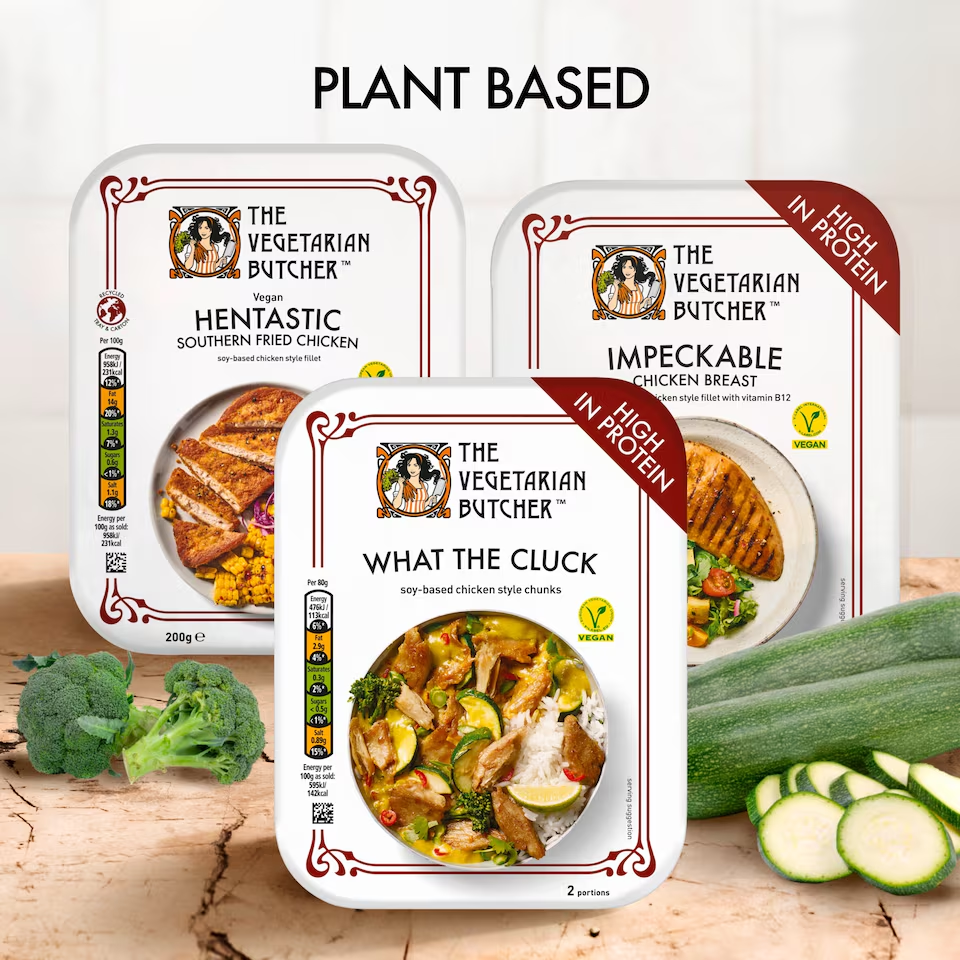
- The Vegetarian Butcher – Dutch creator of plant-based meat products from chicken to meatballs and shawarma.
- BeneMeat – German biotechnology company providing end-to-end technology for cultivated meat manufacturing.
Brand identity and communication
Companies working in the plant-based space often lean into ‘meaty’ language across branding and marketing, and consumers across Europe recognize them for it. Disallowing these terms would mean they’d need to rebuild their brands from the inside out and alter how they currently communicate with consumers.
“We’re such a consumer-facing company,” explains Pascal Bieri, CEO of Planted, “and since we’re talking about consumer-facing language with this regulation, it’s basically at the core of what we do.”
Planted’s products, for example, all comprise the ‘meaty’ name of what they replicate – planted.duck, planted.bratwurst, and planted.schnitzel, enabling consumers to understand the intended use of these products. Meanwhile, La Vie’s plant-based pork products, which include lardons, ham, and bacon, also feature cartoon images of pigs on the packaging (happy pigs eating vegan bacon), further leaning in to the fact that meat is central to their brand. The Vegetarian Butcher even evokes meat in its name! If a plant-based butcher is unable to call their plant-based mince ‘mince’, for example, what will that mean for their brand identity and how they communicate to consumers?
Rutger Rozendaal, CEO of The Vegetarian Butcher, shares his concerns: “Our brand is built on bridging the gap between traditional meat culture and plant-based innovation,” he says. “Consumers choose The Vegetarian Butcher precisely because our products resemble animal meat in taste, texture, shape, and preparation. This proposed legislation would limit our ability to communicate that value clearly.”
Let’s dive deeper into the topic of clarity. How would the new regulations affect consumers’ ability to recognize plant-based products?
Nicolas Schweitzer, CEO of La Vie, puts it simply: “It would make everything less clear. Everyone understands what ‘plant-based bacon’ means, but if tomorrow we can’t write it on the pack, we’ll just end up showing a picture… and people might actually get confused.”
“The real risk lies with consumers,” agrees Claudia Hauschild, Head of Communications & Sustainability at Rügenwalder Mühle, which produces a large offering of successful plant-based products and animal-based ones. “If we were forced to abandon familiar terms like burger or schnitzel, we’d risk losing the clarity and recognition shoppers rely on. It’s not confusion we’d be solving, it’s confusion we’d be creating.”
If leading food companies think the new rules will reduce clarity, an important question stands: are consumers actually confused by ‘meaty’ terms on plant-based products, as policymakers suggest?
“People understand perfectly well what a vegan burger is,” continues Hauschild. “It’s right there in the name. We see this every day at the shelf: shoppers navigate easily between our classic meat products and our plant-based ones because the labeling is already transparent. Germany’s current system, with clear vegan and vegetarian identifiers, works well and could serve as a good model for the EU. In our experience, clarity comes from good information, not from banning familiar words.”
Rozendaal agrees: “Research, including from Dutch consumer program Radar and European consumer group BEUC, shows that consumers clearly understand what a veggie burger or plant-based sausage is. These names clarify expectations, rather than confuse them. Replacing these familiar names with vague or unfamiliar alternatives would make it harder for consumers to understand how to use the product, what it tastes like, and how it fits into their meals.”
“At Planted, we’re selling hundreds of thousands of units a day,” adds Bieri. “As much as I’d like personally, for someone to think our products are meat, I’ve never had somebody confuse a plant-based item with an animal product.”
Our interviewees also worry about how communication might look going forward. What will plant-based products be called, and how will shoppers recognize them?
Bieri comments: “The regulations would mean that we as a company – and we as an industry – need to find words that describe to a consumer what a ‘plant-based schnitzel’, for example, is in the future. I don’t know what that is yet. I don’t think it would make sense for every company to name them ‘plates,’ ‘discs,’ ‘structures,’ whatever. I don’t even know… what is a disk? Is it a burger? Is it a schnitzel? It adds to confusion.”
“We’d have to re-educate consumers from scratch,” adds Hauschild. “Imagine trying to sell ‘plant-based disks’ or ‘protein slices’ – it simply doesn’t resonate. The industry would spend millions explaining what used to be self-evident.”
Business operations and cost
Behind the brand and messaging challenges lie more concrete concerns: cost, logistics, and operational disruption.
For Rügenwalder Mühle, the scale is substantial. Hauschild warns that renaming products is far from a simple packaging tweak: “We’d have to rename and relabel a large part of our portfolio, potentially up to 70% of our plant-based range. That’s not a cosmetic change; it would mean redesigning packaging, updating logistics, and replacing inventory across all markets. Early internal estimates suggest this could cost us a mid-single-digit million euro sum, depending on transition periods and whether existing packaging can still be used. We’d need to update every touchpoint: packaging, advertising, retail listings, recipe communications, and search terms online. Even supermarket planograms and shelf labels would need to be changed.”
Rozendaal adds that inconsistent rules across markets would further complicate operations and increase costs: “At The Vegetarian Butcher, we’d need to tailor packaging and messaging per market, which is inefficient and undermines the coherence of our brand across borders.”

And for brands managing long packaging lead times or large stock holdings, the proposal adds a waste problem on top of a financial one. Schweitzer notes the consequences for La Vie: “It’s an enormous waste issue. We sometimes have a year’s worth of packaging stock; having to throw all that away would be both financially and environmentally absurd.”
“There’s also a serious risk of losing customers,” Rozendaal adds. “If consumers can no longer easily identify plant-based alternatives, they may turn away from them altogether. That would slow down the protein transition and hurt both sustainability goals and business performance.”
Market fairness and competition
Several business leaders also place this proposal in a broader pattern, one of regulatory pressure aimed at slowing, rather than supporting, the growth of alternative proteins.
Schweitzer is honest about the parallels with past battles: “The meat lobbies tried to push this in France already. The only reason it’s back at an EU level is that some politicians are chasing short-term approval from the meat industry and animal farmers, rather than focusing on the long-term, obvious benefits of promoting plant-based food for the population they should serve.”
The legal precedent in France, he argues, shows the weakness of the underlying case: “The meat lobbies fought tooth and nail, and they lost (twice)… because the proposal simply doesn’t make sense.”
If plant-based companies are forced to abandon clear, familiar product names while meat companies continue using universally recognized terms, the result could be an uneven playing field. Plant-based brands risk losing customers simply because consumers no longer understand what their products are, while conventional meat retains full linguistic clarity, and with it, a significant commercial advantage.
What this could mean for hybrid products
Click to read…
Hybrid products, which combine plant-based matrices with cultivated components (e.g., cultivated fat or tissue), could face even greater uncertainty. These products sit at the intersection of two frameworks: general food law for the plant-based portion and Novel Foods for the cultivated portion.
If plant-based items lose access to familiar functional terms such as ‘burger’ or ‘steak,’ hybrids may be left without practical, truthful descriptors, even when a portion of the product is meat (cultivated).
Katharina Eist, leading Business Development at BeneMeat, explains the challenge clearly: “Hybrid products would become especially difficult to label,” she says, “because they are neither conventional meat nor purely plant-based. Restrictive terminology would leave companies without a truthful and functional way to describe the product.”
What’s at stake for Europe’s protein transition?
A setback for innovation and climate goals
The EU has stated ambitions to diversify protein sources, strengthen food security, reduce emissions, and support healthier diets. Plant-based foods are essential to meeting the 2030 climate objectives. Restrictive labeling could hamper this progress dramatically.
“Instead of restricting these terms,” Rozendaal says, “The Vegetarian Butcher believes there is a real opportunity to accelerate positive change, empowering consumers with clarity, supporting innovation, and driving the protein transition forward. By embracing familiar language, we can make sustainable choices more accessible and ensure Europe remains a leader in the plant-based movement! If consumers can’t recognize these products, it becomes harder to choose sustainably. Innovation may shift to regions with more supportive policies.”
Hauschild agrees: “Restricting language that helps people understand how to use plant-based products would create friction, not momentum. Companies may focus on markets with more pragmatic, evidence-based regulation, places that support consumer choice and category growth, rather than complicating it. In the long run, that would weaken Europe’s leadership in sustainable food innovation.”

“Business relies on certainty,” Bieri adds. “You want predictability from lawmakers, from people across your supply chain. You don’t want to be taken by surprise. This is the opposite. Where do you invest as a plant-based company now? For all companies with plant-based products, this is not an economy-friendly policy.”
While cultivated meat has its own regulatory route, restrictive interpretations of naming rules could influence investor confidence, slow down approvals, and leave Europe lagging behind regions like the US, Singapore, and Israel. BeneMeat is already operating in the EU pet food sector, and Eist notes that “clear frameworks are essential, and their absence is already delaying meaningful market entry.”
If the EU adopts stricter naming conventions than other major markets, cultivated meat companies – and hybrid producers in particular – may find Europe a more difficult environment in which to scale.
Economic harm to a growing European sector
Europe currently leads the global plant-based meat market (USD 2.47 billion in 20241). The sector supports farmers (especially pulse growers), drives rural diversification, and contributes to soil health and sustainability.
Restricting labeling would reduce high-value opportunities for farmers, undermine the single market, and add unnecessary administrative complexity.
“This proposal really undermines the progress the industry has made,” Bieri explains, “The investments going in, the innovation happening, the effort to make our protein supply chain more resilient – all of that.”
Eist adds: “Europe has the opportunity to lead globally, but only if it creates a level playing field for innovators.”
At a moment when the EU aims to lead in sustainable food innovation, this proposal sends mixed signals: funding alternative proteins on one hand, restricting their communication on the other.
What the industry wants policymakers to do
Across all interviews, companies were unified in their recommendations:
- Maintain existing labeling freedoms: Current regulations already require clear plant-based identifiers.
- Support clarity: Enable consumers to understand how a product tastes, cooks, and fits into meals.
- Harmonize standards across Europe: Avoid country-by-country fragmentation that burdens businesses.
- Use evidence-based, proportionate regulation: Reflect consumer research, not industry lobbying.
- Support, not hinder, the protein transition: Create a policy environment that fosters innovation and strengthens Europe’s competitiveness.
Hauschild emphasizes actionable, constructive alternatives: “The EU should focus on clarity, not restrictions. A harmonized European labeling framework, with consistent descriptors and a recognizable ‘plant-based’ or ‘vegan’ icon, would make products instantly identifiable.”
Such measures, she argues, would enhance transparency, simplify trade, and build consumer trust, without banning familiar language.
Rozendaal adds: “Europe has a unique opportunity to lead globally in the development and adoption of plant-based meat. By embracing innovation and supporting clear, consumer-friendly labeling, the EU can set the standard for the rest of the world.”
“A future-proof regulatory framework,” explains Eist, “should support all responsible forms of innovation and give every company the tools to describe its products in a way that is both truthful and easy for consumers to understand.”
Looking ahead

Europe stands at a crossroads. The plant-based sector is innovating rapidly, consumers are embracing more sustainable food choices, and policymakers are searching for ways to future-proof the food system. The proposed labeling restrictions threaten to pull these efforts in the wrong direction, creating confusion rather than clarity, administrative burden rather than alignment, and barriers rather than opportunities.
Whether the trilogue negotiations reinforce or revise these restrictions will shape the future of Europe’s food landscape. The path forward is clear: fair, science-based, innovation-friendly regulation that empowers consumers, strengthens the single market, and accelerates the protein transition.
With supportive policy, Europe can lead the world in sustainable food innovation. With restrictive labeling, it risks slowing progress at a critical moment.
Be part of the solution and add your name to the open letter calling for the European Parliament to drop this proposal, and sign the petition against it.
For more support on your alternative protein strategy, or to learn about our Global Programs, get in touch with our experts at [email protected]. Don’t forget to subscribe to our newsletter and podcast!


Gemma Tadman
Business Communications Manager