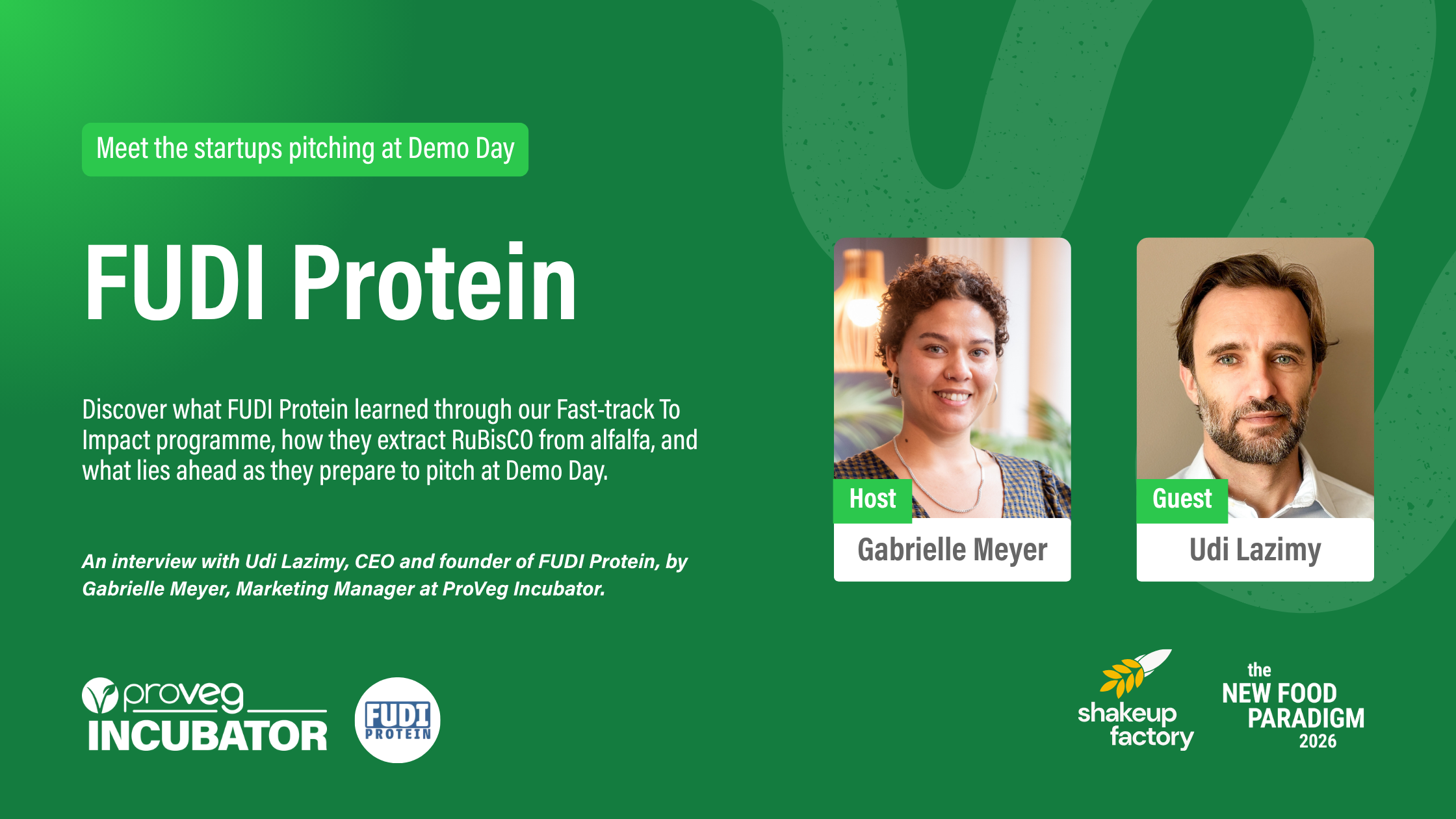
What if a protein already found in plants could help food manufacturers reduce their reliance on egg white? For Udi Lazimy, Founder and CEO of FUDI Protein, that is the opportunity behind RuBisCO.
RuBisCO is a complete protein found in all plant leaves. FUDI Protein is developing a way to extract it from alfalfa, creating a functional protein ingredient for food applications. By using an existing crop, FUDI aims to avoid additional farmland while turning an existing agricultural crop into a functional protein ingredient for food applications.
In this interview, Gabrielle Meyer, Marketing Manager at ProVeg Incubator, speaks with Udi about FUDI Protein’s approach to extracting RuBisCO from alfalfa, its progress towards commercial production, and how the Fast-track To Impact program helped the team refine its business strategy and focus on extraction efficiency.
Why extract protein from alfalfa?
When Gabrielle asked Udi about the problem that inspired FUDI Protein, he pointed to the limitations of both animal and plant proteins. Animal-derived proteins can be expensive and raise sustainability concerns, while many plant proteins fall short on the functionality or sensory qualities required by food manufacturers.
FUDI’s approach is to commercialize RuBisCO, a protein found in the leaves of plants. According to Udi, it offers a combination of nutritional completeness, neutral taste and functional performance that could make it useful across several food categories.
“FUDI captures a highly functional, tasteless, colorless, and complete protein called RuBisCO from the leaves of plants,” he explained.
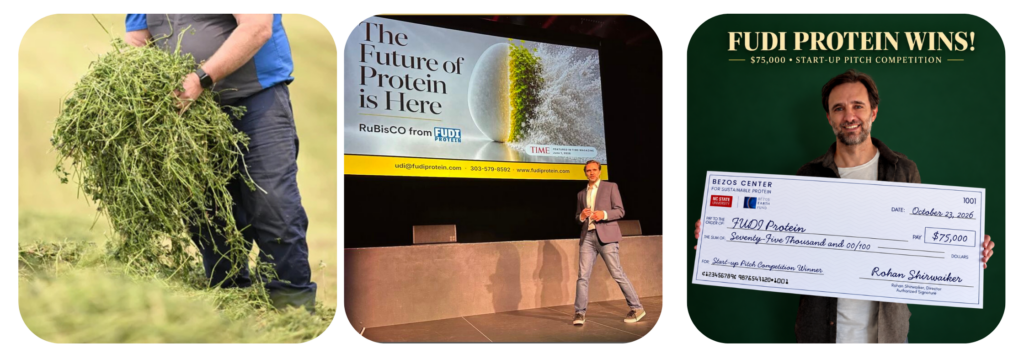
The company has chosen to start with alfalfa, a crop already grown at scale to feed dairy cows. Rather than building an entirely new supply chain, FUDI plans to extract the protein directly on farms and return the remaining high-value biomass to farmers.
The model is designed to make better use of existing agricultural resources while improving the economics of protein production.
An egg white alternative with multiple applications
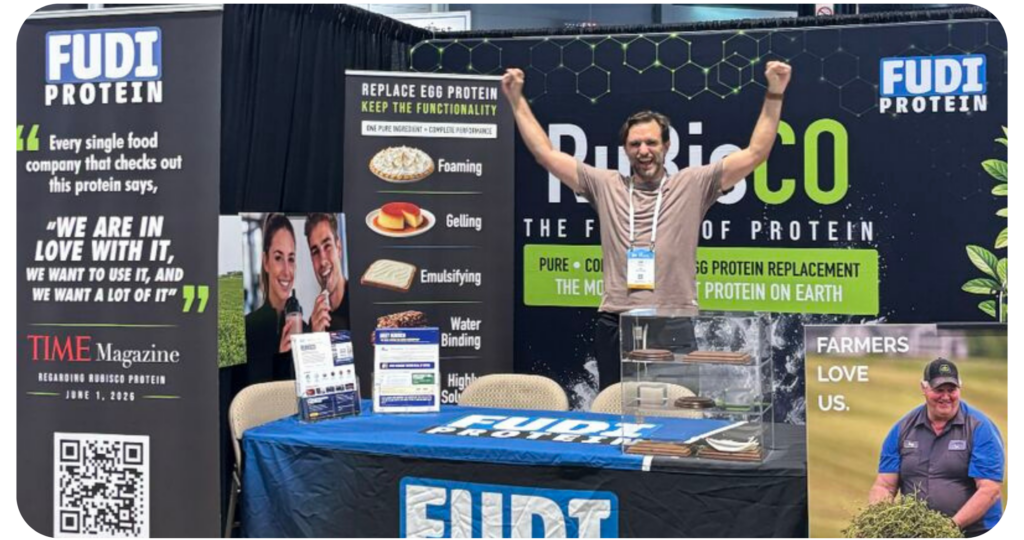
Gabrielle also asked Udi what makes FUDI’s technology different from existing protein ingredients. A key part of the answer is functionality.
FUDI’s proprietary process extracts a white, neutral-tasting, non-allergenic RuBisCO isolate from alfalfa. The company says its protein matches egg white on foaming, gelling and emulsifying performance, properties that are important in applications ranging from bakery and confectionery to beverages and sports nutrition.
Udi describes the ingredient as a 1:1 egg white protein replacement, with a protein digestibility corrected amino acid score (PDCAAS) of up to 1.0. This combination of functionality and nutritional quality could make it particularly relevant to manufacturers looking for alternatives to conventional egg white protein.
Cost is another part of the proposition. FUDI aims to price its ingredient around 35% below egg white by extracting protein on the farm and selling the remaining biomass back to farmers as feed. Its model builds on more than 17 million existing acres of alfalfa in the United States, using mobile processing units and off-the-shelf equipment rather than requiring new land or extensive feedstock infrastructure.
For Udi, the opportunity is to make a highly functional protein commercially viable by rethinking not only the ingredient itself, but also how it is produced and supplied.
From the lab bench to industry testing
One of FUDI Protein’s biggest achievements so far has been demonstrating that its extraction process works beyond the laboratory.
Between August and October 2026, the company worked with university pilot partners to produce kilogram-scale batches of nearly white, functional RuBisCO isolate from alfalfa. According to Udi, these batches are being prepared as samples for food companies, marking an important step towards testing the ingredient in real-world formulations.
The company has also reported strong interest from potential customers. Udi shared that major food and ingredient businesses, including Mars, Kraft Heinz, General Mills, Frito-Lay, Coca-Cola, Cargill, Ingredion, Givaudan and Roquette, have asked to evaluate FUDI’s protein.
The startup has built a pipeline of more than 100 qualified leads and signed material transfer agreements with major global ingredient companies. Green Boy Group has also backed the company, while media coverage from outlets including TIME, AgFunderNews, FoodNavigator-USA and Yahoo Finance has helped raise its profile.
FUDI has also been testing the other half of its circular business model: the remaining fiber biomass. In preliminary third-party analysis reviewed by the director of the USDA-ARS U.S. Dairy Forage Research Center, the co-product scored 68% in total digestible nutrients, compared with 58% for average alfalfa hay.
For Udi, this result supports the potential of the two-product model: farmers receive a higher-value feed co-product, while FUDI can work towards producing protein at a competitive cost.
Refining the business model through Fast-track To Impact
During the interview, Gabrielle asked Udi whether FUDI’s strategy or financial model had changed during the Fast-track To Impact program. He explained that the program helped the team improve its financial model and pitch, while strengthening its understanding of how extraction yield affects the business.
That last point was particularly important. FUDI’s economics depend not only on producing a functional protein, but also on extracting enough of it efficiently to make the process commercially competitive.
When Gabrielle asked about the most valuable piece of strategic advice the team received, Udi’s answer was direct: “That we need to have our yield improve in our extraction process.”
Improving yield is central to FUDI’s ability to move from pilot batches to commercial volumes while maintaining the protein’s color, taste and functionality. It also has a direct impact on production costs and the company’s goal of offering a lower-cost alternative to egg white.
For Udi, the program provided a concentrated opportunity to work on the business fundamentals that matter most when bringing a foodtech innovation to market. He summed up its value as “a highly effective and concentrated opportunity to improve and hone the various most important aspects of founding a food tech company and bring it to market.”
His advice to other early-stage foodtech founders considering the next cohort was even more concise: “Do it.”
The challenge ahead: scaling without compromising quality
FUDI’s next major hurdle is moving from kilogram-scale pilot batches to continuous, on-farm production while preserving the qualities that distinguish its protein.
As Udi explained, RuBisCO begins to degrade within hours of harvest. Producing a consistently white, neutral-tasting and functional isolate at commercial volumes, and at a cost below egg white, is therefore a central execution challenge.
The team is working through this in stages. Pilot runs with university partners are helping establish process parameters that preserve color, taste and function. FUDI is also designing its first mobile processing unit around those parameters, using off-the-shelf equipment, while conducting functional tests throughout the process.
Alongside this technical work, the company is preparing its Generally Recognized as Safe (GRAS) dossier for the US market. Udi sees the regulatory pathway as well-defined, citing the existing GRAS status of alfalfa and FDA precedent relating to leaf RuBisCO.
FUDI is raising a $2.5 million pre-seed round to fund its first mobile processing unit, GRAS filing, a provisional patent on its process and the team needed to operate it. The company plans to follow with an $8 million seed round once commercial production begins.
As a B2B ingredient business, FUDI is focused on partnerships rather than retail distribution. It is looking for food and ingredient companies willing to conduct bench trials and production pilots, ingredient distributors that can introduce the protein to formulators, and alfalfa growers and dairy operations that can support its feedstock supply and purchase the fiber co-product.
Udi said investors with experience in food, agriculture and ingredient processing can bring particular value, especially when they can also open doors to customers, offtake partners, farmers and cooperatives.
“The future is in plant leaves”

When Gabrielle asked Udi which food system leader he would most like to meet over dinner, he chose the head of Grupo Bimbo. His question would focus on a challenge familiar to large-scale food manufacturers: how to secure the functional proteins needed for products when conventional ingredients such as eggs, egg white and whey become too expensive or difficult to source.
He would also want to explore how FUDI’s RuBisCO could help manufacturers address that challenge while reducing ingredient costs.
The ambition behind FUDI extends beyond replacing a single ingredient. Udi wants to meet society’s protein needs more sustainably, without clearing additional land or relying on inefficient production systems. He also sees an opportunity to enable the rewilding of agricultural land currently used to grow crops such as soy and corn.
His prediction for the future of food is clear: “The future is in leaves, which unlocks the ability to produce enough protein for the growing population of planet Earth.”
Selected to Pitch at ProVeg Incubator Demo
FUDI Protein was selected to pitch at the ProVeg Incubator Demo Day following its participation in Cohort 1 of the Fast-track To Impact program.
ProVeg Incubator Demo Day will take place at The New Food Paradigm 2026, hosted by ShakeUp Factory.