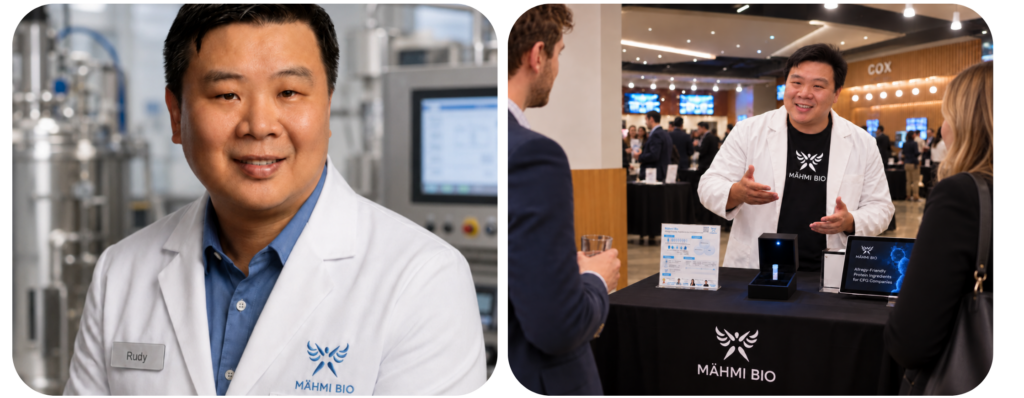
For families living with food allergies, enjoying everyday foods can come with anxiety, restrictions and constant label-checking. For Rudy Ham-Zhu, CEO of Mähmi Bio, this is not just a market gap. It is a personal mission.
As a father of children with multiple food allergies, Rudy has seen firsthand how food can become a source of fear rather than enjoyment. Combining this personal experience with his background in biotechnology and industrial fermentation, he founded Mähmi Bio to rethink how the food industry approaches allergens.
The startup uses AI-guided protein discovery and fermentation to develop novel, allergen-free protein ingredients designed to deliver the taste, texture, functionality and nutrition people expect from familiar foods, starting with dairy alternatives.
In this interview, Gabrielle Meyer, Marketing Manager at ProVeg Incubator, speaks with Rudy Ham-Zhu, CEO of Mähmi Bio, about the personal motivation behind the company, its approach to protein innovation, and how the Fast-track To Impact program helped sharpen its commercial strategy.
From personal experience to a mission for food freedom
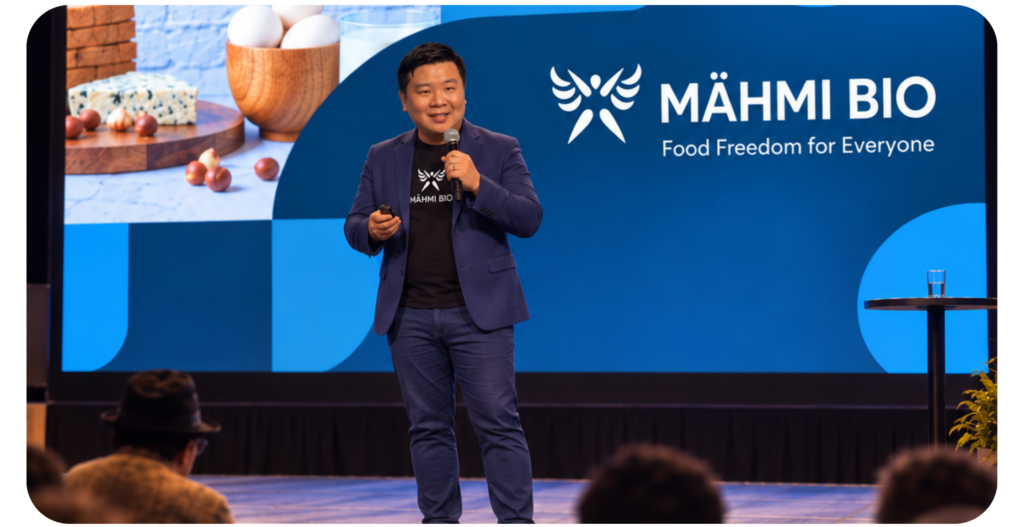
“Mähmi Bio was born from both a personal experience and a fundamental failure in our food system,” Rudy explained.
For people with food allergies, avoiding certain ingredients is often the only practical option. But removing an allergen does not necessarily preserve the taste, texture or nutritional qualities it provided. Alternatives can rely on complicated formulations, added sugars, gums and emulsifiers, or substitutions that introduce other common allergens.
Rudy saw an opportunity to approach the problem differently.
“As a scientist with extensive experience in biotechnology and industrial fermentation, I realized we could approach this problem differently,” he told Gabrielle. “Instead of trying to imitate food with complicated formulations, why not make the proteins themselves?”
Mähmi Bio uses AI to identify proteins that could deliver the functionality of familiar food proteins without the associated allergens. Fermentation is then used to produce these proteins, which the startup supplies as ingredients to food manufacturers.
Rather than asking consumers to compromise on the foods they love, Mähmi Bio wants to give manufacturers new building blocks for developing familiar products with different protein ingredients.
For Rudy, this is about more than improving a formulation. It is about making food more inclusive for people who have too often been left with limited choices.
When asked which food system challenge he would solve overnight, he returned to the experience that inspired the company.
“If I could change one thing overnight, it would be to make every food accessible to everyone, regardless of their allergies or dietary restrictions,” he said. “Not by asking people to compromise on taste, nutrition, or experience, but by removing the barriers that prevent them from enjoying the foods they love.”
Ultimately, he said, that is what drives Mähmi Bio: Food Freedom for Everyone.”
Rethinking what protein innovation can deliver
Much of the alternative protein industry has focused on replicating conventional proteins or bringing production costs down to price parity. Mähmi Bio is taking a different approach: developing proteins around the functionality they can offer.
Unlike alternatives that rely on a long list of ultra-processed ingredients or allergens to imitate dairy, Mähmi Bio focuses on protein discovery itself..
Their approach is designed to address several important properties at the protein level, including taste, texture and nutrition, while avoiding specific allergens.
Rudy believes this creates an opportunity beyond competing on price alone.
“We’re not trying to make cheaper proteins,” he explained. “We’re creating proteins with functionality that conventional proteins cannot offer, unlocking markets that traditional ingredients cannot adequately serve.”
The company operates on a B2B ingredient model, working with food manufacturers rather than building a consumer brand from scratch. This allows Mähmi Bio to pursue applications through existing food production and distribution channels, with dairy alternatives as its starting point.
The technology is still progressing towards commercial readiness, and further protein optimisation, fermentation scale-up and regulatory work remain important next steps. But its ambition is clear: to make allergen-free functionality a feature built into the ingredient, rather than something manufacturers must try to compensate for through additional formulation.
Proving the technology and building commercial momentum
Mähmi Bio has reached technical proof of concept, demonstrating the feasibility of its approach to developing allergen-free proteins. The team has also secured early commercial interest from food manufacturers.
Rudy shared several milestones that indicate the startup’s progress:
- Two letters of interest (LOIs) from food manufacturers interested in its ingredients.
- $200,000 in investment commitments, including support from a family office and physicians specializing in immunology.
- Medical endorsements from physicians affiliated with UCLA and UC San Diego.
- Selection for three accelerator programs: Techstars, Alchemist and the ProVeg Incubator.
One commercial development stands out in particular. Rudy explained that one company had initially rejected Mähmi Bio’s technology but reconsidered after seeing the startup’s progress.
This experience reflects the work involved in introducing a new ingredient category to the market. Scientific feasibility is essential, but manufacturers also need to understand how an ingredient addresses their needs and how it could fit into their existing products.
The next stage involves moving from proof of concept towards commercial readiness, with further protein optimisation, fermentation scale-up and a clear regulatory pathway. Mähmi Bio is also navigating the pending changes in the self-affirmed Generally Recognized as Safe (GRAS) status in the United States.
For a startup developing novel proteins, these steps require both capital and careful planning. Mähmi Bio is therefore prioritizing promising regulatory pathways, existing fermentation infrastructure and commercial partnerships as it works towards scale-up.
The advice that changed Mahmi Bio’s commercial story
When Gabrielle asked Rudy about the most valuable feedback he received through ProVeg Incubator’s Fast-track To Impact program, he highlighted a shift in how the company communicates its technology.
The most important advice was to focus less on the proteins themselves and more on the functionality and value they deliver to customers.
As Rudy explained, this helped Mähmi Bio move from a technology-driven narrative to a market-driven one. Rather than leading with the science, the team became more focused on explaining why a food manufacturer would want to use its ingredients.
The program also helped the team sharpen its customer targeting and distinguish genuine commercial opportunities from broader industry interest. Rudy noted that interest from large corporations can sometimes reflect technology scouting rather than a concrete intention to buy or develop a product.
That distinction matters for a startup working towards commercialisation. Understanding who the customer is, what problem needs solving and what steps are required to convert interest into a paid trial can help direct limited resources where they are most useful.
Rudy has also experienced the difference between generalist and food-specific accelerator programs, having participated in Techstars and Alchemist.
“What makes ProVeg’s Fast-track To Impact program different is its deep understanding of the food ecosystem,” he said. He highlighted the value of access to industry experts, potential customers and strategic partners who understand the particular challenges of bringing food innovations to market.
He summed up the difference simply:
“Generalist accelerators teach you how to build a startup; the Fast-track To Impact program connects you with the people who can help you succeed in food.”
Mähmi Bio is seeking to raise funds to advance its technology from proof of concept towards commercial readiness.
The funding will support protein optimisation and fermentation scale-up, so that with one more round of funding Mähmi Bio will start commercializing its first ingredient: MP+, a dairy protein alternative completely devoid of allergens. On the commercial side, the company wants to convert its existing letters of intent into paid trials, joint development agreements and, ultimately, commercial ingredient supply.
Rudy is looking for strategic partnerships with food manufacturers, ingredient companies and fermentation partners. He is also particularly interested in investors with experience in food ingredients, biotechnology and industrial fermentation, as well as established relationships across the food industry.
Rudy believes the future of food will be shaped not just by cheaper proteins, but by proteins with new functionalities that can make food healthier, safer and more accessible.
A dinner table full of food innovators
Choosing just one dinner guest proved difficult for Rudy. His list includes Richard and Michelle Laver of Kate Farms, Lynn and David Paolella of Cambrooke, Seth Goldman of Honest Tea and Beyond Meat, Dr. Andrew Abraham of Orgain, and Denise Woodard of Partake Foods.
What connects these entrepreneurs, he explained, is the way some turned personal experiences with nutrition, health and food allergies into businesses, while others challenged conventional thinking about the food industry.
If he could bring them all together, Rudy would ask two questions: how they convinced investors and customers they were creating a new market rather than serving a small niche, and which decisions helped them turn a differentiated food product into a scalable business.
He would also want to know what they would do differently in today’s foodtech investment environment.
These questions reflect the challenge Mähmi Bio is tackling now: showing that allergen-free proteins can address a meaningful unmet need and building the commercial partnerships required to bring them to market.
Selected to Pitch at ProVeg Incubator Demo Day
Mähmi Bio was selected to pitch at the ProVeg Incubator Demo Day following its participation in Cohort 2 of the Fast-track To Impact program.
ProVeg Incubator Demo Day will take place at The New Food Paradigm 2026, hosted by ShakeUp Factory.