How can fermentation help turn underused food industry side streams into nutritious, functional ingredients? Turkish foodtech startup MATRIA Biotechnology is exploring this opportunity by combining circular resource use with sequential fermentation using two complementary yeasts.
Rather than focusing on protein alone, MATRIA aims to develop multifunctional ingredients that offer nutritional value and improved sensory properties, ready to be incorporated into everyday foods. Its initial focus is on bakery side streams and applications, providing a concrete starting point for its broader technology platform.
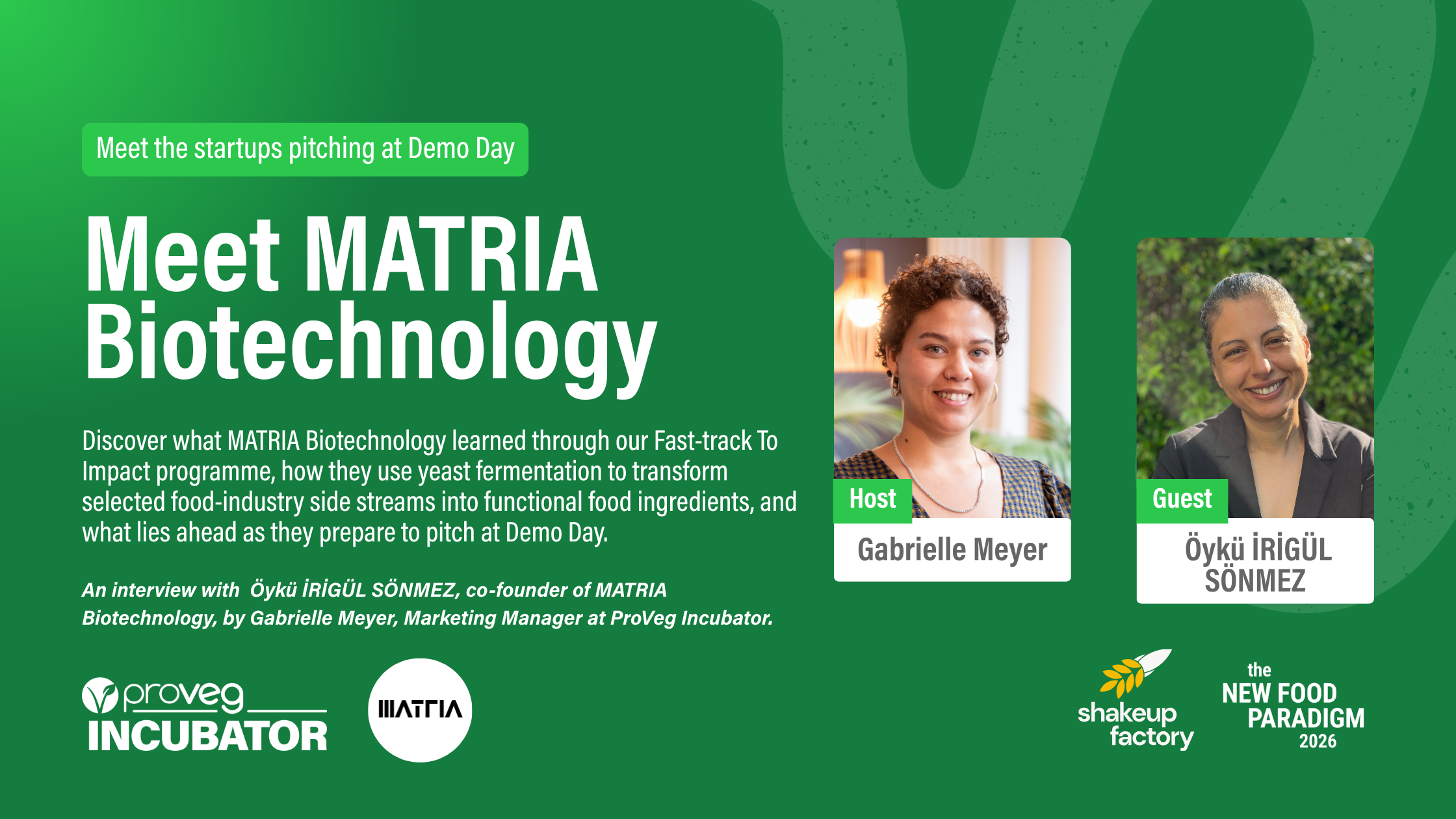
In this interview, Gabrielle Meyer, Marketing Manager at ProVeg Incubator, speaks with Öykü İRİGÜL SÖNMEZ, Co-founder of MATRIA Biotechnology, about the science behind the startup, its progress towards commercialisation, and how the Fast-track To Impact program helped sharpen its commercial strategy.
Turning underused resources into food ingredients
Food production requires significant land, water and energy, while valuable nutrients can be lost or underused across the supply chain. MATRIA wants to help close this gap by transforming food industry side streams into protein-rich, multifunctional ingredients through fermentation.
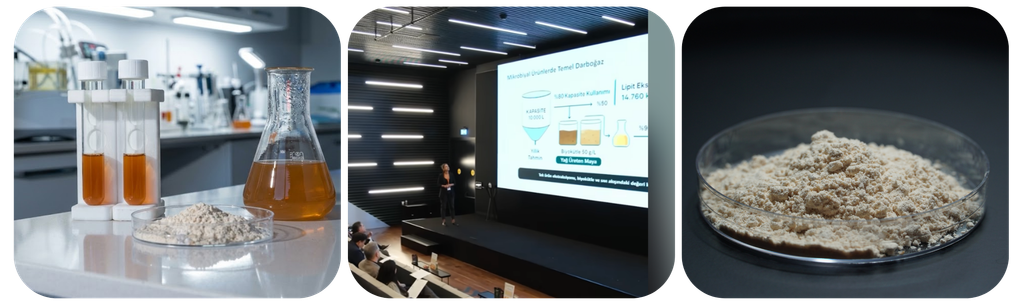
The startup’s process uses two yeasts in sequence to improve the nutritional and sensory qualities of the resulting ingredients. By retaining both yeast biomass and useful fermentation compounds, MATRIA aims to make better use of its raw materials while creating ingredients that food manufacturers can incorporate into familiar products.
Bakery side streams are its initial focus. The team has already progressed from laboratory fermentation to prototype ingredients and food application trials, including cookies made with ingredients derived from bakery side streams.
This approach could offer food manufacturers another way to source functional ingredients while making use of resources that might otherwise go to waste.
From laboratory research to commercial applications
Moving from a promising scientific process to consistent, commercially viable production is a key challenge for fermentation startups. For MATRIA, one of the biggest hurdles is maintaining ingredient quality as it works with different feedstocks and increases fermentation scale.
Food industry side streams can vary in composition, affecting the nutritional and sensory properties of the final ingredient. MATRIA is therefore working on feedstock standardization and process optimisation, with pilot-scale validation planned as its next major technical milestone. Fermentation yields and drying costs are also important considerations as the company works towards commercial production.
The startup has made progress on several fronts. Its selection as a Migros Up finalist has opened an opportunity to develop its circular model with a major retailer, while the ZEROFERM project has secured support from the EIC Pre-Accelerator.
These developments provide a foundation for the next stage: validating production at a larger scale, demonstrating ingredient performance and converting customer trials into paid pilots.
What MATRIA learned through the Fast-track To Impact program
For a science-led startup, explaining the technology is only part of building a business. Potential customers also need to understand what the ingredient offers, how it fits into their products and why it makes commercial sense.
When Gabrielle asked Öykü about the biggest shift in MATRIA’s strategy during the program, she highlighted a sharper commercial focus. While the technology can work with different food industry side streams, mentoring and pitch feedback helped the team identify bakery side streams and bakery applications as a clearer starting point.
The program also encouraged MATRIA to connect its broader platform vision to a specific customer use case, supported by clearer milestones and production economics.
As Öykü explains, the most valuable advice was to make the commercial opportunity as clear as the science. Working with experts, a coach and a mentor helped the team better articulate who would buy its ingredients, why they would choose them and how the business could scale.
For other early-stage foodtech founders considering the program, her advice is to apply with a concrete challenge and make time to act on the feedback. For teams developing complex technologies, an outside perspective can help turn scientific progress into a more focused commercial proposition.
Building partnerships for the next stage
MATRIA is now seeking investment and strategic partnerships to support pilot-scale production, validate ingredient performance and production costs, and move customer trials towards paid pilots.
Its immediate priorities include working with food manufacturers on joint application development and finding partners with fermentation scale-up expertise. Investors with experience in food ingredients and industrial biotechnology could also help the company build the commercial relationships needed to grow.
The long-term ambition extends beyond bakery applications. By developing ways to transform different food industry side streams into useful ingredients, MATRIA hopes to help keep more valuable resources within the food system.
When asked what investors and corporate partners should remember after its pitch, Öykü puts it simply: food industry side streams can become the raw materials for the next generation of nutritious ingredients.
Her broader prediction reflects this ambition: “Tomorrow’s most sought-after food ingredients will come from resources we overlook today, and their circular origins will be a selling point.”
MATRIA Biotechnology at Demo Day
MATRIA Biotechnology was selected to pitch at ProVeg Incubator Demo Day following its participation in Cohort 2 of the Fast-track To Impact program.
ProVeg Incubator Demo Day will take place at The New Food Paradigm 2026, hosted by ShakeUp Factory.