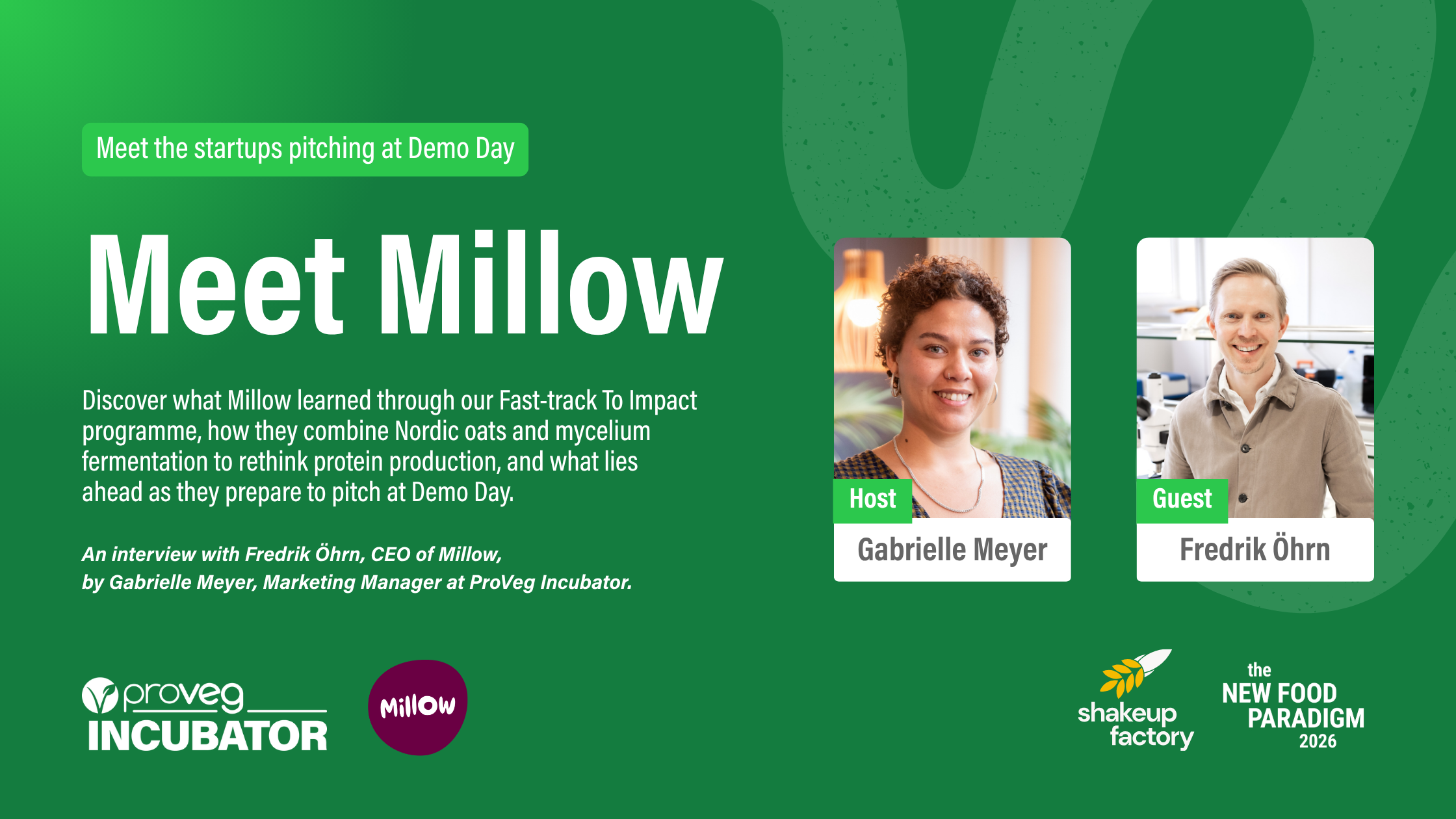
What happens when locally sourced Nordic oats meet the power of mycelium fermentation? Swedish foodtech startup Millow is bringing the two together to create a protein-rich, whole-food ingredient designed to make sustainable protein more affordable and accessible.
Using a patented solid-state fermentation process, Millow harnesses a food-grade fungus to transform oats into Millow mince in just 16–24 hours. By combining a locally available crop with its fermentation technology, the startup aims to offer an alternative to conventional meat and highly processed plant-based products.
As one of the 10 startups pitching at ProVeg Incubator Demo Day at The New Food Paradigm 2026, hosted by ShakeUp Factory, Millow is showcasing its approach to producing protein using local resources and innovative fermentation.
In this interview, Gabrielle Meyer, Marketing Manager at ProVeg Incubator, speaks with Fredrik Öhrn, CEO of Millow, about the technology behind the product, the journey towards commercial production, and his vision for a more localized food system.
Where Nordic oats meet mycelium fermentation

Millow was founded in response to a challenge in the alternative protein market. Many plant-based meat alternatives have relied on imported protein isolates, long ingredient lists and highly processed formulations. Millow set out to explore a different approach by rethinking how protein-rich food can be produced.
Its solution combines two key elements: Nordic oats and mycelium fermentation.
The company uses a food-grade fungus to ferment oats through a patented solid-state process. In just 16–24 hours, this transforms the oats into Millow mince, a whole-food ingredient designed for use in foodservice and other food applications.
The product contains 14g of protein and 7.3g of fiber per 100g. Millow also reports a climate footprint of 0.32kg CO₂e per kilogram, verified by RISE, Sweden’s research institute. The product is gluten-free and classified as non-novel in the EU.
By starting with locally available Nordic oats rather than relying on imported protein isolates, Millow combines its fermentation technology with a local sourcing approach. And the potential extends beyond oats: the process can also work with other crops and agricultural side streams, opening up opportunities to adapt production to resources available in different regions.
For Millow, the ambition is to turn locally available crops into protein-rich food through mycelium fermentation — creating a scalable platform rather than just a single product.
Making sustainable protein commercially viable
For Millow, sustainability and nutrition are only part of the equation. Price and scalability are equally important.
The company aims to combine a short ingredient list, nutritional value and a low climate footprint with a competitive price. According to Millow, its mince sells below the price of beef and other animal-based mince, allowing foodservice customers to explore alternatives without paying a premium.
Its production model also offers flexibility. By using locally available crops and potentially agricultural side streams, Millow aims to reduce dependence on imported protein ingredients and bring production closer to customers.
This could create opportunities beyond Millow mince itself, enabling food and ingredient companies to explore applications using the same fermentation platform.
From research to commercial production

Millow’s technology builds on 25 years of fermentation research. One of the company’s biggest milestones has been moving from the laboratory towards industrial production and commercial deliveries.
In August 2026, its European process patent passed the opposition period unopposed. The company has also received confirmation of its non-novel status in the EU and achieved IP Livsmedel food security certification in September 2026.
Commercially, Millow progressed from its first customer delivery at a major Swedish music festival in summer 2026 to paid deliveries through a leading Nordic foodservice wholesaler.
Further opportunities are developing across contract catering, public-sector kitchens, hotels, restaurants and fresh-food retail. Millow has also signed an agreement with a large agribusiness for its broader technology platform, with the first invoice exceeding €150,000.
Its first S-unit bioreactor is operating in Stenkullen, Sweden, with production targeted at approximately 150kg per day from November 2026.
The next priority is to make production consistent and repeatable at scale. Millow is focusing on stabilizing its first industrial unit and working with a selected group of pilot customers to refine production and delivery before expanding capacity.
Learning to sell value, not just technology
Millow entered ProVeg Incubator’s Fast-track To Impact program with a B2B strategy. During the program, the team sharpened its understanding of its target customers and how to communicate the value of its product.
The company is focusing on Nordic foodservice wholesalers, contract caterers and public kitchens, where taste, clean-label ingredients, local origin, price and verified climate performance can influence purchasing decisions.
One piece of advice from a ProVeg mentor particularly stuck with Fredrik: “Sell value to the customer, not technical functionality.”
Rather than leading with the science behind mycelium fermentation, Millow focuses on what matters to buyers: a tasty, affordable mince with a short ingredient list and a lower climate footprint.
The team also learned the importance of selecting a manageable number of pilots and following them closely, rather than pursuing every commercial opportunity at once. This approach is helping Millow refine its production and delivery processes as it prepares to scale.
For Fredrik, the value of the program lies in gaining honest feedback and understanding which parts of a startup’s story customers and investors actually respond to.
What comes next for Millow?

Millow is raising a Seed+ extension to support the ramp-up of its first production unit and its commercial pilots. Beyond funding, the company is looking for partners who can help introduce its product to new European markets, develop co-branded products and explore licensing opportunities for its fermentation technology.
Its ambitions extend beyond Sweden. By adapting its process to different crops and agricultural side streams, Millow sees potential to support local protein production in a range of markets.
For potential investors, the opportunity lies in scaling a patented technology with paying customers and a growing commercial pipeline. For corporate partners, Millow offers a platform that could support new product development and more localized protein production.
Fredrik predicts that within ten years, fermented whole-food protein will increasingly be produced near the cities where it is consumed, using crops already growing in surrounding regions.
Building a more localized protein system
If Fredrik could solve one food system challenge overnight, he would make the true cost of food visible in its price, ensuring that climate, land and water impacts are reflected in purchasing decisions.
He believes that when the food system rewards ingredients with smaller environmental footprints, sustainable protein will be able to compete on price rather than relying on consumers and businesses to choose it on principle alone.
Millow’s approach reflects that ambition: combining Nordic oats with mycelium fermentation to create protein-rich food that is designed to be nutritious, affordable and more sustainable.
And when asked what keeps him going through the challenges of building a foodtech company, Fredrik returns to a simple principle:
“Sell value, one kilo at a time.”
For Millow, every delivery is a step towards demonstrating that combining locally available crops with mycelium fermentation can move beyond the laboratory and become part of the everyday food system.
Selected to Pitch at ProVeg Incubator Demo Day
Millow was selected to pitch at the ProVeg Incubator Demo Day following its participation in Cohort 1 of the Fast-track To Impact program.
ProVeg Incubator Demo Day will take place at The New Food Paradigm 2026, hosted by ShakeUp Factory.