What if the by-products of plant-based beverage production could help food manufacturers simplify ingredient lists and preserve food for longer? Foodtech startup NOIET is exploring this opportunity by transforming nutrient-rich residues into multifunctional ingredients through fermentation.
At the heart of its technology is okara, the protein- and fiber-rich residue left over from producing plant-based beverages. While this material is often underused, NOIET sees an opportunity to unlock its potential and turn it into something valuable for food manufacturers.
In this interview, Gabrielle Meyer, Marketing Manager at ProVeg Incubator, speaks with Lorenzo Paolini, Co-founder and CEO of NOIET, about the problem inspiring the startup, the progress it has made towards commercialisation, and how the Fast-track To Impact program helped reshape its approach to customers.
Rethinking what counts as waste
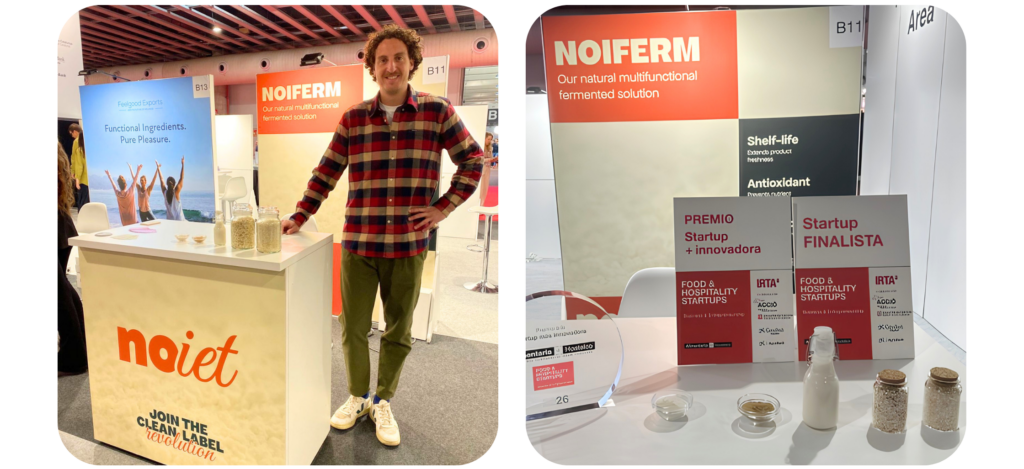
“Every liter of plant-based beverage leaves behind a wet residue called okara,” Lorenzo explained. “It’s rich in protein and fiber, but that value is underutilized, since the industry treats it as animal feed or a disposal cost.”
NOIET wants to change that by turning food industry side streams into ingredients that can serve multiple purposes at once. Its proprietary fermentation process uses a consortium of microorganisms to unlock existing protein and fiber while generating compounds with antimicrobial and antioxidant activity.
The result is a new generation of multifunctional ingredients designed to help food manufacturers address several formulation needs with a single ingredient.
Its products, NOIFERM Oat and NOIFERM Rice, combine nutritional value with food-protection properties. NOIFERM Oat is rich in protein and fiber, while NOIFERM Rice offers a high-protein, gluten-free option. Both are designed to support simpler ingredient declarations, such as fermented oat flour or fermented rice flour.
For Lorenzo, the opportunity goes beyond creating another alternative protein. As he explained to Gabrielle, the message he wants investors and corporate partners to remember is that NOIET is “not building another alternative protein” but creating a new category from material the food industry currently pays to dispose of.
From laboratory results to commercial interest
One of NOIET’s most important technical milestones came when the team ran its process with an external partner and achieved results comparable to those obtained in its own laboratory. Lorenzo identified this as a particularly important moment because it demonstrated progress beyond the startup’s own research environment.
The commercial pipeline is also taking shape. NOIET reports that it is in active dialog with 32 companies across 12 countries, has signed 11 non-disclosure agreements, and has eight companies testing samples. The startup has also secured its first Letter of Intent.
These figures indicate growing interest in the technology, but the next challenge is converting that interest into pilot agreements and repeatable production.
When asked about the biggest hurdle to scaling, Lorenzo pointed to drying. “Drying is the step that drastically increases costs,” he explained. “At industrial scale, the wrong drying process makes the system economically unavailable.”
Finding the right production process and partners will therefore be essential. NOIET is looking for contract manufacturers with existing fermentation and drying capacity who can help it maintain a standardized process as production grows.
The advice that changed how NOIET talks to customers
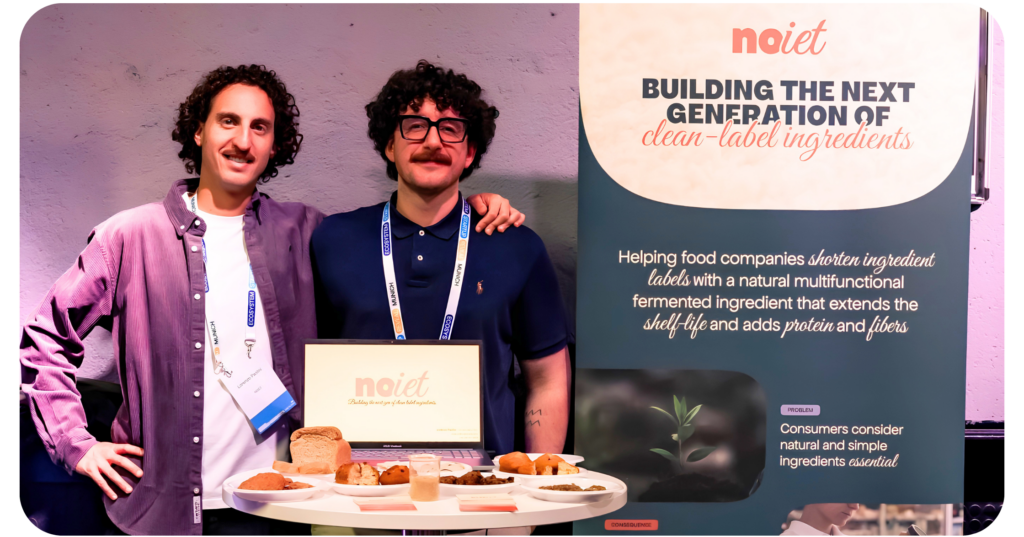
When Gabrielle asked Lorenzo about the most valuable advice he received through ProVeg Incubator’s Fast-track To Impact program, he described a change in how the company communicates its technology.
“We’d been opening every conversation with the full multifunctional story, and it was quietly working against us because of skepticism and confusion,” Lorenzo said.
The team realized that trying to explain every benefit at once could make it harder for potential customers to understand the immediate value. Instead, NOIET now leads with the function that addresses a specific customer problem, introducing the other benefits later.
Lorenzo described the shift as follows:
“Identical product, described in the order someone can actually absorb it. It’s the cheapest change we ever made and one of the most valuable.”
The lesson was not about changing the technology, but about making its value easier to understand. By focusing first on a customer’s most pressing need, NOIET could communicate a clearer commercial proposition and create a more direct route towards product validation.
Reflecting on the program more broadly, Lorenzo said the team entered feeling confident about its positioning but left having rebuilt it. He believes challenging those assumptions helped strengthen the company’s commercial pipeline.
His advice to other early-stage foodtech founders is to apply even if they feel their science is not yet fully developed, provided they want to improve their commercial strategy, positioning or fundraising.
“The honest value isn’t the network or the funding, useful as both are,” he explained. “It’s being made to test the assumptions you’ve been quietly protecting.”
For Lorenzo, the program’s value can be summed up in one sentence: “Fast-Track taught us which single sentence of our technology a customer actually buys.”
Raising €500K to reach the next milestones
NOIET is now raising a €500,000 pre-seed round to reduce the risks standing between its current development stage and industrial validation.
Lorenzo explained that the funding is focused on three priorities:
Supplying its first committed pilot: securing the volume needed to move from an initial commitment to a pilot.
Building the evidence customers need: commissioning an accredited, third-party analytical dossier to support customer trials and pilot agreements.
Extending patent protection: filing a Patent Cooperation Treaty (PCT) application ahead of its February 2027 priority deadline, with the aim of extending protection into Europe and the United States.
At Technology Readiness Level 5 (TRL 5), NOIET sees industrial reproducibility and customer-ready documentation as important requirements for progressing with larger manufacturers.
Alongside investment, the startup is seeking partnerships with contract manufacturers and food producers who can support fermentation scale-up, drying and application development.
When asked what type of investor would bring the most value, Lorenzo highlighted the importance of sector knowledge and practical connections. He is looking for investors who understand the food industry and can introduce the right people at the right time to help solve problems and accelerate progress.
A future where preservation means something good
NOIET’s ambition also challenges how the food industry thinks about preservation. Lorenzo believes that within ten years, the word “preservative” will no longer automatically suggest a chemical ingredient on a label.
It is a vision that aligns with NOIET’s approach: developing ingredients from underused resources that could help manufacturers address food protection and formulation challenges at the same time.
When asked which food system challenge he would solve overnight, Lorenzo returned to the idea at the heart of the company: making better use of existing resources.
“I’d make it impossible for edible material to be classified as waste simply because it left the main production line,” he said. “Almost nothing in this industry is actually waste. It’s material that nobody has found a use for yet, and the word ‘waste’ is what stops anybody looking.”
For NOIET, this is about more than finding a new use for okara. It is about changing how the food industry recognizes the value of materials that already exist.
A dinner conversation about fermentation and scale
To close the interview, Gabrielle asked Lorenzo which food innovator he would invite to dinner. His choice was David Zilber, who led the fermentation lab at Noma before moving into industrial biotechnology.
Lorenzo explained that Zilber’s journey connects closely with the one NOIET is navigating today, moving from fermentation science towards industrial application.
“Because we’re making a similar journey right now, and I’d rather learn from someone who’s already arrived than discover things at 1,000 litres,” he said.
It is a fitting choice for a founder focused on turning fermentation research into a scalable commercial process.
Selected to Pitch at ProVeg Incubator Demo Day
NOIET was selected to pitch at the ProVeg Incubator Demo Day following its participation in Cohort 2 of the Fast-track To Impact program.
ProVeg Incubator Demo Day will take place at The New Food Paradigm 2026, hosted by ShakeUp Factory.