



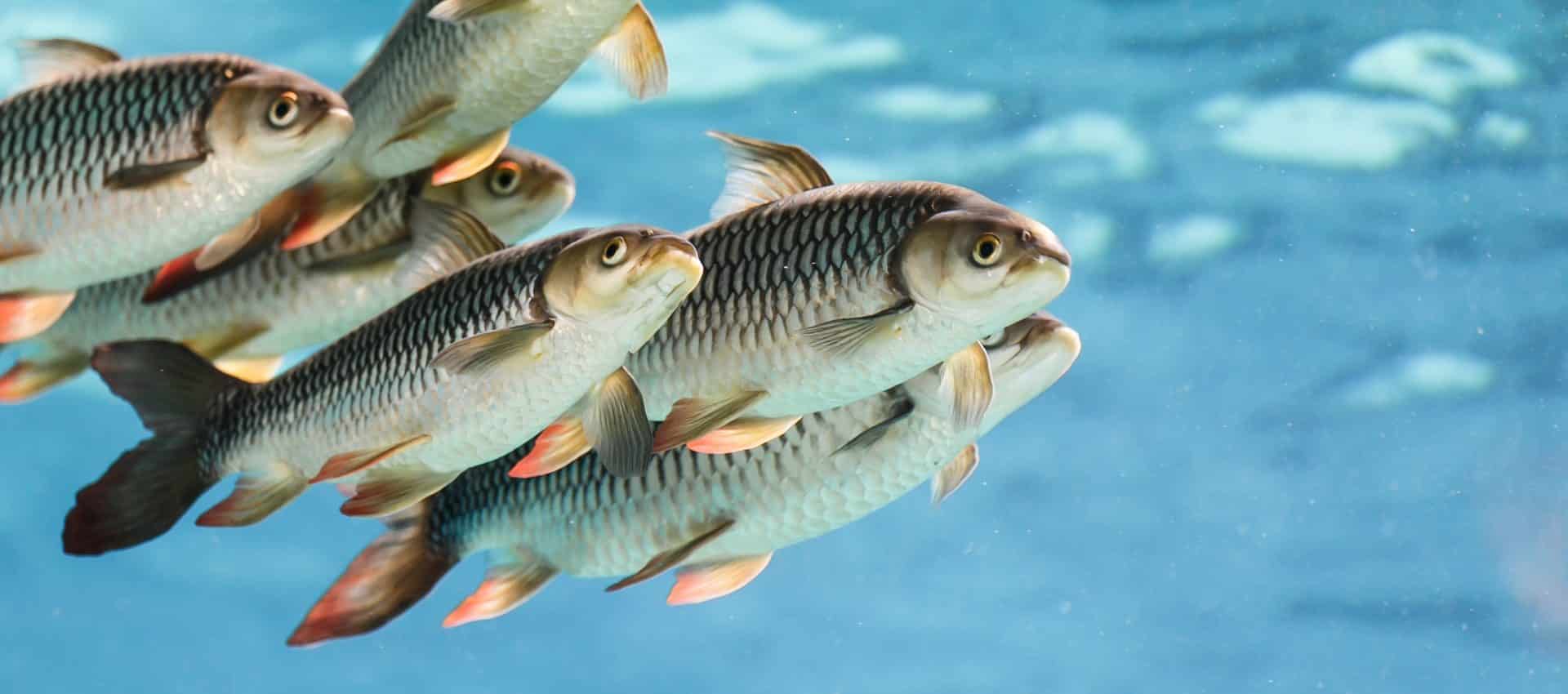
The global food system relies heavily on aquatic animals. However, the growing demand for fish places significant environmental pressure on marine and freshwater ecosystems, raising concerns about the sustainability of current production levels. The resulting impacts include the overexploitation of fish stocks, major losses in biodiversity, and destructive fishing practices.
Sources
[1] OECD/ FAO (2025): OECD-FAO Agricultural Outlook 2025-2034. Available at: https://data-explorer.oecd.org/vis
[2] FAO (2025): Food Balances (2010-). FAOSTAT. Available at: https://www.fao.org/faostat/en/#data/FBS [Accessed: 20.09.2025]
[3] Mood, A. & P. Brooke (2024): Estimating global numbers of fishes caught from the wild annually from 2000 to 2019. Animal Welfare 33 e6. doi:10.1017/awf.2024.7
[4] Mood, A., E. Lara, N. K. Boyland, et al. (2023): Estimating global numbers of farmed fishes killed for food annually from 1990 to 2019. Animal Welfare 32 e12. doi:10.1017/awf.2023.4
[5] FAO (2025): Crops and livestock products. FAOSTAT. Available at: https://www.fao.org/faostat/en/#data/QCL [Accesseed: 20.09.2025]
[6] FAO (2024): The State of World Fisheries and Aquaculture 2024 – Blue Transformation in action. Rome.
https://doi.org/10.4060/cd0683en
[7] Kroodsma, D. A., J. Mayorga, T. Hochberg, et al. (2018): Tracking the global footprint of fisheries. Science 359(6378), 904–908. doi:10.1126/science.aao5646
[8] He, F., C. Zarfl, V. Bremerich, et al. (2019): The global decline of freshwater megafauna. Global Change Biology 25(11), 3883–3892. doi:10.1111/gcb.14753
[9] Pacoureau, N., C. L. Rigby, P. M. Kyne, et al. (2021): Half a century of global decline in oceanic sharks and rays. Nature 589(7843), 567–571. doi:10.1038/s41586-020-03173-9
[10] Ault, J. S., S. G. Smith, M. W. Johnson, et al. (2022): Length-based risk analysis of management options for the southern Florida USA multispecies coral reef fish fishery. Fisheries Research 249 106210. doi:10.1016/j.fishres.2021.106210
[11] Hatton, I. A., R. F. Heneghan, Y. M. Bar-On, et al. (2021): The global ocean size spectrum from bacteria to whales. Science Advances 7(46), eabh3732. doi:10.1126/sciadv.abh3732
[12] Our World in Data (2021): Fish and Overfishing. Available at: https://ourworldindata.org/fish-and-overfishing [Accessed: 20.09.2025]
[13] MSC (n.D.): Fishing methods and gear types. Available at: https://www.msc.org/what-we-are-doing/our-approach/fishing-methods-and-gear-types [Accessed: 20.09.2025]
[14] Richardson, K., B. D. Hardesty, J. Vince, et al. (2022): Global estimates of fishing gear lost to the ocean each year. Science Advances 8(41), eabq0135. doi:10.1126/sciadv.abq0135
[15] Lebreton, L., S.-J. Royer, A. Peytavin, et al. (2022): Industrialized fishing nations largely contribute to floating plastic pollution in the North Pacific subtropical gyre. Scientific Reports 12(1), 12666. doi:10.1038/s41598-022-16529-0
[16] Frenkel, C., M. Eadie, A. Murphy, et al. (2023): Why, and where, is commercial fishing gear lost? A global review and case study of Pacific Canada. Marine Pollution Bulletin 196 115528. doi:10.1016/j.marpolbul.2023.115528
[17] Pérez Roda, M.A. (ed.), E. Gilman, T. Huntington, S.J. Kennelly, P. Suuronen, M. Chaloupka & Medley, P. (2019): A third assessment of global marine fisheries discards. FAO Fisheries and Aquaculture Technical Paper No. 633. Rome, FAO. 78 pp.
[18] R. W. D. Davies, S. J. Cripps, A. Nickson, and G. Porter (2009): Defining and Estimating Global Marine Fisheries Bycatch. Marine Policy 33, no. 4, S. 661–72.
[19] Gilman, E., A. Perez Roda, T. Huntington, et al. (2020): Benchmarking global fisheries discards. Scientific Reports 10(1), 14017. doi:10.1038/s41598-020-71021-x
[20] Gilman, E., A. Perez Roda, T. Huntington, et al. (2020): Benchmarking global fisheries discards. Scientific Reports 10(1), 14017. doi:10.1038/s41598-020-71021-x
Frequently asked questions
What are the key facts about global fishing and overfishing?
38% of global fish stocks were overfished in 2021 — more than ever before. Up to 2.3 trillion wild fish are caught each year (fish are usually counted by weight, not number). Industrial fishing operates across more than 55% of the global ocean — four times the area used by agriculture on land. Studied coral-reef fish show an 85% overfishing rate; sharks and rays have declined 71% since 1970.
How much of the world’s fish stocks are overfished?
38% of global fish stocks were overfished in 2021 — more than ever before. Fish are usually counted by weight rather than number, which obscures the scale: up to 2.3 trillion wild fish are caught each year, placing intense pressure on ocean ecosystems already at or beyond sustainable limits.
What is the environmental impact of global fishing?
Industrial fishing operates across more than 55% of the global ocean — four times the area used by agriculture on land — driving steep biodiversity loss. Studies report an 85% overfishing rate among studied coral-reef fish, a 71% decline in sharks and rays since 1970, plus widespread bycatch, habitat damage and abandoned “ghost” fishing gear.