


Every year, on 1 October, we celebrate World Vegetarian Day: a day to reflect on the power of plant-based diets to help improve public health, reduce the environmental impact of our food choices, and spare billions of animals from industrial farming. With more and more people making the move towards plant-based eating, let’s take a look at how this transition can positively affect the planet, and how small changes in our eating habits can have a lasting impact.
The data doesn’t lie: the environmental impact of our food choices
Because food production is one of the single largest contributors to environmental degradation, making changes to our dietary choices can significantly reduce this impact.
Animal agriculture is particularly resource-intensive, with studies showing that it uses vast amounts of water and land, while also contributing significantly to greenhouse gas emissions. According to ProVeg’s Food System Data, farmed animals are responsible for 32% of global human-made methane emissions.1 Methane is a potent greenhouse gas, second only to carbon dioxide in its overall contribution to global warming.
Another key impact of animal-based diets is their disproportional use of arable land. Agriculture is the leading cause of deforestation and biodiversity loss – nearly 80% of the world’s agricultural land is used for livestock, yet it produces less than 18% of calories, globally.2 This imbalance highlights the inefficiency of meat-based diets, compared to more plant-centered diets.
If everyone on earth adopted a fully plant-based diet, 76% less land would be needed for agriculture. This would free up an area of land the size of Africa.3
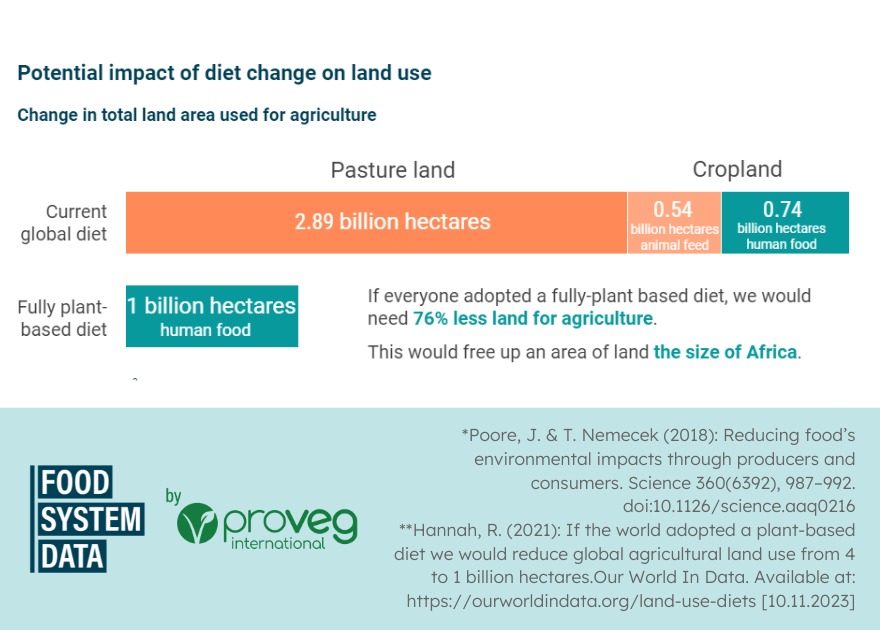
Switching to a vegetarian diet can reduce the demand for land, water, and energy, thus lowering overall environmental pressure. These changes, although they may seem small on an individual level, can collectively lead to large-scale benefits for the environment.
The health benefits of going vegetarian
Beyond the positive impact on the planet, adopting a vegetarian diet can also have strong personal health benefits. Numerous studies have linked plant-based diets to a lower risk of chronic diseases, including heart disease, cancer, and diabetes.4 A well-planned vegetarian diet provides a balanced intake of essential nutrients such as vitamins, antioxidants, and fiber, which can improve overall well-being.
Factory farming also poses serious public health risks: in the US alone, water pollution from factory farms threatens or impairs over 13,000 miles of rivers and streams and more than 90,000 acres of lakes and ponds. These concentrated animal feeding operations (CAFOs), generate billions of pounds of animal waste annually, which contain substances that seriously degrade rivers and contribute to antibiotic resistance in humans – prompting the American Public Health Association to call for a ban on new CAFOs.5
In addition to the health and environmental factors, a vegetarian lifestyle is more ethical, since it leads to dramatically reduced animal suffering. Every year, approximately 80 billion animals are raised and slaughtered for food6, usually in conditions that raise ethical concerns about animal welfare. Reducing or eliminating meat consumption can lower the demand for factory farming, and reduce the number of animals that are killed for food.
World Vegetarian Day is an opportunity to reflect on these realities. The growing plant-based movement offers a practical and powerful approach to many of the world’s environmental challenges. As well as mitigating the harmful effects of climate change, plant-based eating can also lead to healthier and more sustainable food systems.
Make a difference with the Veggie Challenge
If you’re considering making the shift towards a vegetarian or vegan diet but aren’t sure where to start, ProVeg’s Veggie Challenge is the perfect opportunity to explore plant-based eating. This 30-day challenge provides meal ideas, nutritional guidance, and personal support, while showcasing the tangible impact that one person can make.
By taking the Veggie Challenge and trying a plant-based diet for just 30 days, you can achieve the following:
- Avoid the deaths of up to two farmed animals.
- Reduce carbon emissions by up to 143 kg of CO2-eq – a significant decrease, considering the extent to which animal agriculture contributes to climate change.
- Save up to 13,200 liters of water. Water is an essential resource that is overused in livestock production. For example, it takes about 15,000 liters of water to produce just 1 kg of beef.
- Free up to 377 square meters of land, which could be used instead for reforestation, thus helping to increase biodiversity.

Take action today – sign up for the Veggie Challenge
World Vegetarian Day 2025 arrives at a moment of both great promise and numerous challenges. The demand and appetite for plant-based eating is continuing to grow and food-systems change is more crucial than ever. Yet levels of meat consumption are also continuing to rise, and the path from dietary curiosity to sustained changes in our eating patterns still leaves much to be desired.
Choosing to eat plant-based, even partially, remains one of the most effective personal actions you can take for your health, the climate, and farmed animals. Every meal switch, every conversation, and every campaign helps to push society closer to a more sustainable, humane food system.
So why not start changing your diet today? Take the Veggie Challenge and see the difference you can make in just 30 days!


Joy Aquino
International Digital Marketing Manager
- https://foodsystemdata.org/climate-change/ ↩︎
- https://foodsystemdata.org/land-use/ ↩︎
- https://foodsystemdata.org/land-use/ ↩︎
- https://www.ncbi.nlm.nih.gov/pmc/articles/PMC10548756/ ↩︎
- https://www.greenqueen.com.hk/livestock-farming-animal-agriculture-factory-farming-climate-change-discourse-meat-slaughtered/ ↩︎
- https://ourworldindata.org/data-insights/billions-of-chickens-ducks-and-pigs-are-slaughtered-for-meat-every-year ↩︎